Education….......…Public Policy….......…Advocacy …......…Participation……......Recognition......
Welcome
...to the website of the James McGregor Stewart Society. We want to change the outlook for people confronting barriers. Please share this site with friends.
Your contributions, comments and criticisms will add enthusiasm and vitality.
Please participate by subscribing!
Click here (opens a new window)
Statement of Purpose......... Take Action!......... Become a Member......... Contact
Please participate by subscribing!
Click here (opens a new window)
Statement of Purpose......... Take Action!......... Become a Member......... Contact
Showing posts with label History. Show all posts
July 19, 2015
Monday Reading
A brief History of the Curb Cut. Still being written seventy -count 'em 70 - years later in Halifax.
July 13, 2015
Helen Keller in Halifax
| Helen Keller, Anne Sullivan and Alexander Graham Bell in Baddeck |
For brains, courage, achievement and impact, few surpass Helen Keller. Not many know that she spent the summer of 1901 here, nor that she was absolutely enchanted by the place. There's a lot to the story, including a visit to Baddeck:
My favourite amusement is sailing. In the summer of 1901 I visited Nova Scotia, and had opportunities such as I had not enjoyed before to make the acquaintance of the ocean. After spending a few days in Evangeline's country, about which Longfellow's beautiful poem has woven a spell of enchantment, Miss Sullivan and I went to Halifax, where we remained the greater part of the summer. The harbour was our joy, our paradise. What glorious sails we had to Bedford Basin, to McNabb's Island, to York Redoubt, and to the Northwest Arm! And at night what soothing, wondrous hours we spent in the shadow of the great, silent men-of-war. Oh, it was all so interesting, so beautiful! The memory of it is a joy forever. One day we had a thrilling experience. There was a regatta in the Northwest Arm, in which the boats from the different warships were engaged. We went in a sail- boat along with many others to watch the races. Hundreds of little sail-boats swung to and fro close by, and the sea was calm.
When the races were over, and we turned our faces homeward, one of the party noticed a black cloud drifting in from the sea, which grew and spread and thickened until it covered the whole sky. The wind rose, and the waves chopped angrily at unseen barriers. Our little boat confronted the gale fearlessly; with sails spread and ropes taut, she seemed to sit upon the wind. Now she swirled in the billows, now she sprang upward on a gigantic wave, only to be driven down with angry howl and hiss. Down came the mainsail. Tacking and jibbing, we wrestled with opposing winds that drove us from side to side with impetuous fury. Our hearts beat fast, and our hands trembled with excitement, not fear; for we had the hearts of Vikings, and we knew that our skipper was master of the situation. He had steered through many a storm with firm hand and sea-wise eye. As they passed us, the large craft and the gunboats in the harbour saluted and the seamen shouted applause for the master of the only little sail-boat that ventured out into the storm. At last, cold, hungry and weary, we reached our pier.
The Story of My Life by Helen Keller
Chapter XXII excerpt
I have already written of my first meeting with Dr. Alexander Graham Bell. Since then I have spent many happy days with him at Washington and at his beautiful home in the heart of Cape Breton Island, near Baddeck, the village made famous by Charles Dudley Warner's book. Here in Dr. Bell's laboratory, or in the fields on the shore of the great Bras d'Or, I have spent many delightful hours listening to what he had to tell me about his experiments, and helping him fly kites by means of which he expects to discover the laws that shall govern the future air-ship. Dr. Bell is proficient in many fields of science, and has the art of making every subject he touches interesting, even the most abstruse theories. He makes you feel that if you only had a little more time, you, too, might be an inventor. He has a humorous and poetic side, too. His dominating passion is his love for children. He is never quite so happy as when he has a little deaf child in his arms. His labours in behalf of the deaf will live on and bless generations of children yet to come; and we love him alike for what he himself has achieved and for what he has evoked from others.
The Story of My Life by Helen Keller Chapter XXIII excerpt
Naturally, I
was curious about who HK was visiting in Halifax, so I
wrote to the American Foundation for the
Blind, which seems to have her
correspondence. The archive was lost on
9/11, so I am unsure of how the AFB was
able to locate four letters written by HK
from Halifax which they sent to me. I have them on paper somewhere, but can't put my hands on them.
It turns out she and her entourage (Anne Sullivan and Mrs. Ketcham - a name I cannot find elsewhere) were guests of Mr. Fearon at the Institution for the Deaf and Dumb. The three of them had been to visit Grand Pre, and made an unexpected visit to Halifax and Mr. Fearon, who HK had met at a convention. Mrs. Ketcham became ill and they stayed at least three weeks.
I was interested to learn where the Institution was located, and a Google search led me to Halifax resident Maida Barton Follini, Radcliffe ’52, who can pick up the story:
It turns out she and her entourage (Anne Sullivan and Mrs. Ketcham - a name I cannot find elsewhere) were guests of Mr. Fearon at the Institution for the Deaf and Dumb. The three of them had been to visit Grand Pre, and made an unexpected visit to Halifax and Mr. Fearon, who HK had met at a convention. Mrs. Ketcham became ill and they stayed at least three weeks.
I was interested to learn where the Institution was located, and a Google search led me to Halifax resident Maida Barton Follini, Radcliffe ’52, who can pick up the story:
I came up to Amherst in 1980 to take a position as Head of the Fearon Unit (Dept. for Deaf-Blind Children) at APRCHH in Amherst, after previously having taught deaf-blind children at Perkins School for the Blind in Watertown, Mass. (where Helen Keller had attended school briefly before going on to a private girls' school in New York, and thence to Radcliffe).
The Halifax Institution for the Deaf and Dumb (as it was known in old unenlightened days) was located on Gottingen Street in Halifax, and opened in 1857. Its founders were two deaf Scotsmen, living in Halifax: William Grey was a graduate of the Braidwood Academy in Edinburgh, a school for the deaf. He became a tailor in Halifax, but found that there were over 300 deaf persons in Nova Scotia, without benefit of special education. He joined with a deaf friend, George Tait, and opened a school to teach them "in a mean lodging in a poor street”.
Their efforts attracted the attention of Rev. James Cochran, who was a friend of Laurent Clerc, a leading deaf teacher at the Hartford School for the Deaf founded 1817, and Cochran raised money from the NS Gov't and community to establish the Halifax Institution for the Deaf and Dumb which opened in 1857. J. Scott Hutton from the Edinburgh school for the deaf was brought over as principal and the originators, Grey and Tait were retained as teachers. One statement says "it moved into permanent quarters at Brunswick Villa” in 1859. Another statement says the school was located on Gottingen Street. I am not sure whether Brunswick Villa and Gottingen St. are the same place.
I have seen pictures of the old school for the deaf - a large many-storied Victorian building which was sold and pulled down when the School became the Interprovincial School for the Deaf, in Amherst, in 1961. This in turn became the Atlantic Provinces Resource Centre for the Hearing Handicapped. This school closed in 1994 and the program was moved to Halifax to the location of the Sir Simon Fraser School for the Blind, and the residential part of the program was reduced, while the "in the community" part was expanded (itinerant teachers going to public schools.)
When Helen Keller visited Mr. James Fearon, 2nd principal of the school, must have been in charge. His niece, Miss Louise Fearon taught the deaf-blind children and later when a special unit was set up in Amherst at APRCHH it was named the Fearon Unit in honour of her work.
The first deaf-blind child taught at the Halifax school was in 1906, when six year old Mary Jane Veinot who was taught to speak, fingerspell, and read and write Braille by teacher Miss Winifred Conrod. Between 1906 and 1961 when the Halifax school closed, there would typically be 2 or 3 deaf-blind children each year at the School for the Deaf. Miss Fearon taught from one to three deaf-blind children each year for 18 years until her retirement in 1961.
The dates above show that it was probably Helen Keller's visit in 1901 to Mr. Fearon that stimulated him to accept the first deaf- blind child in 1906. Helen no doubt showed what was possible.
Similarly, a half-century earlier, Samuel Gridley Howe, principal of Perkins School for the Blind, had shown that it was possible to educate a deaf-blind child, Laura Bridgman - and through Charles Dickens' visit to the School and his writing about Laura Bridgman, the Keller family learned about the possibility of education for their daughter Helen, and wrote to Dr. Howe who sent them Annie Sullivan to teach Helen.
I hadn't realized the AFB Archive had been lost in 9/11. However, the Perkins School for the Blind in Watertown, Mass., has a wonderful Research Library on the History of Blindness (and deaf-blindness) and I expect has material on Helen Keller of interest.
I retired from APSEA (current name of the organization - Atlantic Provinces Special Education Authority --) in 1994, consulted with them as a free agent another 2 years, then retired completely when they hired another psychologist. Obviously the internet information is out of date. No surprise! But it led you to me!!
As you read HK’s letters, it is a surprise to
notice how often she uses visual terms. You
begin to understand that when she talks
about a splendid view of the sea, she is using
shorthand to describe her own appreciation
of things we experience only visually.
HK was a remarkable person in so many ways. Here is a woman who found her way to a great university and helped break down so many personal and social barriers. Exceptional people help us to see what we cannot always see ourselves, and it is important to give them every opportunity. In its own way, the work of this society has been part of the larger effort to seek out people of unusual accomplishments.
Not to prolong this post too much, but skip ahead to 2015. The Metropolitan Museum of Art has an exhibit:
HK was a remarkable person in so many ways. Here is a woman who found her way to a great university and helped break down so many personal and social barriers. Exceptional people help us to see what we cannot always see ourselves, and it is important to give them every opportunity. In its own way, the work of this society has been part of the larger effort to seek out people of unusual accomplishments.
Not to prolong this post too much, but skip ahead to 2015. The Metropolitan Museum of Art has an exhibit:
This month marks the twenty-fifth anniversary of the Americans with Disabilities Act (ADA). The Met joins many organizations across the city and the nation to celebrate this groundbreaking legislation and honor the achievement of the disability rights movement. The Met's Access and Community Programs educators collaborate with departments Museum-wide to create an accessible and inclusive environment for all visitors.
The Met has a long history of creating programs for visitors with disabilities. In Helen Keller's 1933 Atlantic Monthly article "Three Days to See," she speaks extensively about touching artworks in the Met's collection to "probe into the soul of man through his art."
Today, almost seven thousand people of all ages with disabilities participate in about four hundred programs each year, including people who are blind or partially sighted, those with physical disabilities and mobility impairments, and people with dementia and their care partners.
In addition to the ongoing Access programs and inclusive, multisensory offerings for everyone, more than twenty special programs throughout July will highlight the Met's position as a dynamic site for people with disabilities to connect with art.
Gus Reed
October 3, 2014
Priscilla Pointon
My good friend Maurice Mandale pointed me to DISABILITY: A NEW HISTORY, a BBC radio production with twelve 15 minute episodes. I haven't listened to them all, but in episode 6 we are introduced to Priscilla Pointon.
This from the episode:
"Priscilla Pointon is a poet who is inventing herself as she speaks, and what comes out of her mouth, extempore as she calls it, is a mixture of innocence and feistiness. She made herself the centre of society in Chester, England between about 1760 and 1770.
As a blind poet she wrote about all sorts of different things. She wrote about her life, she wrote about everyday events in her life.
She writes about needing to go to the toilet when she’s visiting friends who’ve given her punch and wine and beer. And she says they’re all, ‘great diuretics’. And she’s surrounded by a group of men who have sent the maids out so there’s no one to take her to the loo."
Priscilla could very well be sitting in a sidewalk cafe in Halifax, facing the problem posed by HRM's failure to consider washroom access as part of its new by-law.
Waiter! Fetch me a chamber pot, if you please.
Priscilla Pointon - Address to a Bachelor on a Delicate Occasion
You bid me write, Sir, I comply,
Since I my grave airs can't deny.
But say, how can my Muse declare
The situation of the fair,
That full six hours had sat, or more,
And never once been out of door?
Tea, wine and punch, Sir, to be free
Excellent diuretics be:
I made it so appear, it's true,
When at your house, last night, with you:
Blushing, I own, to you I said,
'I should be glad you called a maid.'
'The girls,' you answered, 'are far from home,
Nor can I guess when they'll return.'
Then in contempt you came to me,
And sneering cried, 'Dear Miss, make free;
Let me conduct you - don't be nice -
Or if a basin is your choice,
To fetch you one I'll instant fly.'
I blushed, but could make no reply;
confused to find myself the joke,
I sat silent till Trueworth spoke:
'To go with me, Miss, don't refuse,
Your loss the freedom will excuse.'
To him my hand reluctant gave,
And out he lead me very grave;
Whilst you and Chatfree laughed aloud
As if to dash a maid seemed proud.
But I the silly jest despise,
Since well I know each man's that's wise
All affectation does disdain,
Since it in prudes and coxcombes reign:
So I repent not what I've done:
Adieu - enjoy your empty fun.
September 28, 2014
Idiots becoming Lunatics
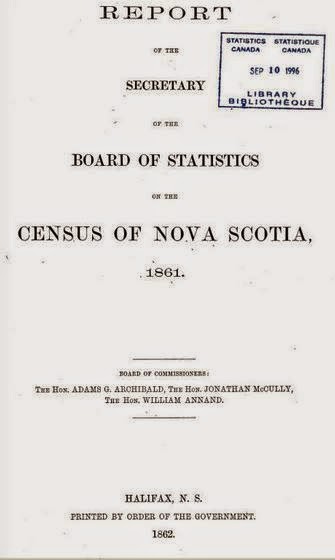
Here are the figures on certain disabilities from the Census of Nova Scotia, taken March 30, 1861, under Act of Provincial Parliament--Chap. XIV--XXIII VIC. (1862)
.............The returns of the Deaf and Dumb show nearly the same number, compared with the population, as in 1851. Some Counties return a less number than in 1851; but this may be accounted for by there being a number in the Deaf and Dumb Institution at Halifax, from the country, and all of which are included in the number from Halifax. There is 1 of this class in every 1100 of the population. In Canada in 1851, there was 1 in 1372, and in the United States 1 in 2395 of the entire population. The proportion of Deaf and Dumb in Great Britain, is 1 to 1590 of the population, in France, 1 to 1212, in Prussia, 1 to 1364, and in Switzerland, 1 to every 503. The average proportion of this class throughout the civilized world, is estimated at about 1 in 1550 of the population.
The report of the Institution for the Deaf and Dumb for 1860, kindly furnished me by the Rev. James Cochran, M. A., the Secretary, who has always taken a deep interest in its management, shows that 42 of this unfortunate class attended the school during the year, 6 of whom belonged to Halifax, 7 were from New Brunswick, and 29 from various parts of this Province— viz.: 7 from the County of Pictou, 4 from Colchester, 4 from Annapolis, 3 from King's, 4 from Cape Breton, 2 from Queen's, and 1 each from Cumberland, Hants, Digby, Sydney, and Guysborough Counties.
In 1851 there were 136 Blind persons returned; the present Census returns 185; showing a somewhat larger proportionate increase than that of the population. There is no means of ascertaining from the returns, how many of these 185 were born blind, or how many became so from disease or old age; it is probable that not more than one-half, if so many, were born blind. I would suggest the propriety, in taking the next Census, so to arrange the schedules that such distinctive information may be obtained.
The number of Lunatics returned shows that this class of unfortunates, during the last decade, has increased in a greater ratio than the population. In 1851 there were 166, being only 1 in 1660 of the whole population ; while the returns for 1861 show 340, including those in the Hospital for the Insane, being 1 in 970 of the population.
A reference to the abstract at the close of the Census report, will show the number of Lunatics belonging to the several Counties, including those in the Asylum. It is difficult to account for this disparity, otherwise than by supposing that they were not all returned in 1851. The number of Idiots does not exhibit a like proportionate increase with that of Lunatics. There were 299 Idiots returned in 1851, and 317 in the present Census. Probably some who were returned in 1851 as Idiots, are now returned as Lunatics.
That explains everything.
September 25, 2014
Lives Worth Living
There is a moving and uplifting PBS documentary Lives Worth Living which chronicles the events leading to the enactment of the Americans With Disabilities Act. in 1990. Here is a 14 minute excerpt, focusing on the politics, personalities and final outcomes. The full DVD is expensive, but may be available at your local library.
24 years on, Nova Scotia badly needs to step up with similar Civil Rights legislation, and indeed has promised to do so.
July 27, 2014
Videos
It's worth remembering that a year ago we were in the middle of an effort to make MLA constituency offices accessible. The analogy to what was accomplished in this short film is unmistakable.
Although our approach was less dramatic, it was equally effective. We are well into the next phase; legislation to enshrine equal opportunity for all Nova Scotians We don't want to squander the opportunity.
For your amusement, here is a wry look at similar legislation in the UK
And the PG-13 sequel
Although our approach was less dramatic, it was equally effective. We are well into the next phase; legislation to enshrine equal opportunity for all Nova Scotians We don't want to squander the opportunity.
For your amusement, here is a wry look at similar legislation in the UK
And the PG-13 sequel
July 14, 2014
Ramping up
For reasons of tradition, the Speaker of the House sits on a slightly raised platform, from which he can see and be seen throughout the Legislature. With Murphy and his wheelchair this requires imagination to accomplish. There could be a lift, whose whirring and noise would seem incompatible with the dignity of the House.
Or, as was decided, a ramp serves well. The ramp is quite unobtrusive. The wood matches, the carpet is quiet, the rope railings lend a nautical theme. The unspoken message that the highest reaches of power are available to all is clear. Joseph Howe would approve.
I visited Kevin a few weeks ago and he graciously let me wheel up the ramp. I overheard a conversation, the gist of which was that the ramp is not up to code. It needs proper railings 42 inches high and some kind of fence. Plexiglass is being proposed.
To me, this would be an example of administrative overreach; a failure to think reasonably and creatively.
Murphy is a capable adult, not prone to veering off the edge in any circumstance. Plexiglass isn't really invisible, and would be an intrusion in the storied chamber. We need to look at this slightly ambiguous situation and decide if it's a problem worth solving. Problems have objectives and context. Solutions sometimes require creativity and compromise.
The secret in this particular situation is that even with a 42 inch railing, this ramp could never be up to code. It's too steep. It really should be fractionally longer, requiring removing the wall at the end. Or removing a desk and having a switchback. Or relocating the Speaker's chair off-center.
- The objective is to get Speaker Murphy, a determined and skilled individual up to a slightly raised position. We cannot fail in this.
- The context is a place of considerable history and architectural significance.
- The solution requires balance and compromise; there are alternatives, but there is a good solution.
So it should be with similar collisions of context and objective. Access to a historic building does't always require a gleaming plexiglass and steel ramp. On Barrington Street, portable ramps might do, or two-level sidewalks, or interior ramps. Access is the certain goal, but how we get there is variable. It serves no purpose to bludgeon people with rigid adherence to rules. Be reasonable, be open to compromise.
And remember,without a Speaker, there is no government.
June 30, 2014
Happy 125th, JMcGS
In a ceremony at 10 o'clock this morning at Camp Hill Cemetery, about 20 people happily observed the 125th birthday of James McGregor Stewart. The gravesite had been completely cleaned, through the good offices of Councilor Waye Mason. June 30, 2014 was proclaimed to be James McGregor Stewart Day in Nova Scotia.
Rev. Paul Friesen provided brief and well chosen words in his invocation:
May we who recollect his faithfulness,
Be barred by no prejudice or fear.
May all who follow in his persistent path,
Rejoice in the gifts granted to each
For the good of all our fellows.and again in his benediction, calling on Providence to:
Scatter the darkness of prejudice from the hearts of the powerful,
And brighten the lives of allRod MacLennan read Kipling's the Thousandth Man with solemnity.
The order of ceremonies was:
- Bagpipes - Neil White
- Invocation - Rev. Paul Friesen
- Reading of the Proclamation and presentation to Mrs. Morrison - Speaker Murphy
- Reading of "The Thousandth Man" - R.J. MacLennan
- Benediction - Rev. Paul Friesen
- Bagpipes
- Most of the attendees gathered for coffee at Just Us afterward
The Proclamation is reproduced here:
June 22, 2014
You are cordially invited.................
to a brief, public graveside ceremony to celebrate the 125th birthday of James McGregor Stewart.
Monday, June 30, 2014, 10:00 o'clock AM
Camp Hill Cemetery
On the circle
The Rev'd Dr. Paul Friesen officiating
Piping Prelude
Invocation - Dr. Friesen
Reading and Presentation of Proclamation - Speaker Murphy
Reading of Kipling's The Thousandth Man - R. J. MacLennan
Benediction - Dr. Friesen
Piping Postlude
James McGregor Stewart, 1889-1955, son of a Pictou lawyer, grandson of a Cape Breton minister, had Polio as a child. He was a principal of Stewart, McKelvey, the downtown Halifax law firm. In his time he was Nova Scotia’s premier corporate lawyer, and he wrote the rules for many of our most successful and long-lived companies. He was president of the Canadian Bar between the wars.
He is one of fewer than 500 Canadians to be awarded the Commander of the British Empire for services to the Empire in WW II. His obituary was in the New York Times. Stewart was a collector of writings by Rudyard Kipling and met Kipling at his home in Sussex in 1932
The Society which bears his name, advocates for fair treatment of Nova Scotians with disabilities and was instrumental in the House of Assembly Management Commission's 2013 decision to require constituency offices to be accessible.
Subscribe to:
Posts (Atom)
.jpg?itok=lc1CNans)