Welcome

...to the website of the James McGregor Stewart Society. We want to change the outlook for people confronting barriers. Please share this site with friends. Your contributions, comments and criticisms will add enthusiasm and vitality.
Please participate by subscribing!
Click here (opens a new window)
Statement of Purpose......... Take Action!......... Become a Member......... Contact
Showing posts with label Sidewalk Cafe. Show all posts

April 12, 2016

Handwashing


One


Readers may remember the Hat Lady of Lunenburg, who wanted to conduct her small business at her home, but ran afoul of requirements for all kinds of expensive improvements.  I wrote Anna at the time:

"I'm always concerned that the penalty from this kind of dispute will ultimately be paid by Nova Scotians with disabilities, who just want to live and work in their communities.  It's too easy to put a finger on one aspect of a complex problem; to blame the wheelchair ramp and the grab bars."

I urged flexibility in Anna's case and a revision of the Building Code.

I guess I got my wish, though not exactly what I anticipated.  I was thinking sole proprietorships, but the changes include home-based businesses with employees

Proposed amendments to the Building code make any home-based business, defined as:

  • secondary to the residential occupancy use of the dwelling unit, 
  • at least 1 full-time resident of the dwelling unit operates the business or service 
  • the business or service use is not a hazardous industrial occupancy 
  • has a floor area of less than 50 m2
  • uses less than 25% of the floor area of the dwelling unit. 

exempt from

  • having additional water closets
  • barrier-free design requirements
Seldom seen in Nova Scotia

What's wrong is that home based businesses could discriminate against employees with disabilities.  A lawyer's office could never have a receptionist that uses a wheelchair.  A massage therapist, a bookkeeper, an architect, a financial adviser, a caterer, a photographer - all could have employees without having to observe section 5 of the Nova Scotia Human Rights Act:


  • No person shall in respect of 
    • (a) the provision of or access to services or facilities; 
    • (d) employment; 
  • discriminate against an individual or class of individuals on account of 
    • (o) physical disability or mental disability; 
We already disregard the Human Rights Act by grandfathering a ton of older businesses. Restaurants, shops, professional services - there are hundreds of places in Nova Scotia that never will accommodate people with disabilities.  Do we need more?

Of course not, and that's why we can't accept this version of code revisions.  At the very least, sole proprietorship home businesses should have a ramp.  Forget the fireproof bathroom and the 36" door.  Make the gesture!  And when you have employees, be barrier-free.

Two


This is the same building code that Chief Public Health Officer Dr. Robert Strang sees as the solution to the problem of food safety posed by accessible restaurants without accessible washrooms.  Such restaurants usually are a result of the addition of accessible sidewalk patios to otherwise inaccessible premises.  Le Coq and The Five Fishermen are examples.  

The fundamental difficulty is that wheelchair users have their hands in constant proximity to their wheels, which, in turn, are inevitably in contact with the filth and corruption of Halifax streets and sidewalks.  Poodles and Shih-Tzus numbering in the thousands provide an inexhaustible source of nutrients for all manner of Parasites and Pathogens.  You need to wash them off before eating a Donair.

Dr. Strang refuses to acknowledge that section 20 of the food safety regulations means what it says:

20 (1) A food establishment must have washroom facilities for staff and washroom facilities for the public available in a convenient location, unless exempted by the Administrator.

Often seen in Nova Scotia
He says: "I do not see Food Safety regulations as the vehicle to push for such change as lack of accessible washrooms for patrons."  I say public means public.

In his patronizing way, he assumes I want accessible washrooms.  I don't.  I want to make it inconvenient for restaurants without them.  I want him to do his job and close or exempt accessible restaurants without accessible public washrooms as the regulations compel him to do.  I may never go to Le Coq, but I want Dr. Strang to close it or put it on a list of places with irregular public health compliance.  When the list is compiled according to the law, I will make sure it is well-advertised.  Then wheelchair users will have the information needed to make up their own minds.  No more surprises.

It is offensive that there is no such list, in particular because it trivializes the legitimate health concerns of wheelchair users.  Wheelchair users are so far down the list of priorities that the provincial government won't even bother to record health issues affecting them.  Dr. Strang is not doing what he's paid to do. In Nova Scotia, we should not accept that you can go to a nice restaurant in 2016 only to discover that basic sanitary needs are unmet.  

And PS a recent restaurant closure was attributed to a cruise ship visitor.


Three


These two things are the same: small issues whose poor resolution leads to outsize consequences for people with disabilities.  Dr. Strang and whoever did the home business exemption don't understand that people with disabilities are entitled to the same treatment as everyone else.  This is not just an option or a nicety, it's a guarantee and a requirement.

It all goes back to the marginalization of people with disabilities.  There are zero people with disabilities on the Ivany Commission, zero in Engage NS, zero in One NS, zero in the Halifax Partnership.  

If you have never met a person with a disability, how can you imagine their circumstances?

Four


Don't you think that Human Rights and Public Health are more important than the Building Code?  How does it happen that someone in Municipal Affairs thinks they can change the Building Code without reference to any other considerations?  Why does an imperfect Building Code make it okay to have unsanitary conditions?  Is everyone asleep at the switch?  I hope the checks and balances in the new accessibility act mean a sharper focus on rulemaking, so that people with disabilities aren't simply ignored.

Gus Reed
 

February 22, 2015

A Winter's Tale


This summer I participated in the minister's advisory panel on accessibility legislation. I was co-chair of the committee on the built environment. We submitted our final report to the minister a week ago. 

I'd like to tell you a story.

We met once on September 10 at the Future Inn up near Bayer's Lake, then agreed to meet four successive Mondays as a group. It had been suggested that we should be mindful of the budgetary pressures of the Department of Community Services, so we cast around for a free accessible location (2 in wheelchairs, one with a cane) and were pleased when Paul Pettipas of the Nova Scotia Home Builders Association volunteered his new space at 124 Chain Lake Drive. Complete with state-of-the-art accessible washroom.

Now Paul is a fine advocate (he's a lawyer) for the NSHBA, but a poor judge of accessibility. After the first meeting I was aware of how inaccessible the washroom was, so at the second meeting all twelve of us adjourned to the washroom and examined in detail the shortcomings of the facility. Misplaced mirrors were an inconvenience, misplaced grab-bars around the toilet were a danger.


You can quibble about the details, but the angled grab bar and missing bar over the tank make the toilet unusable. Most importantly, it's not up to code. If the Nova Scotia Homebuilders Association doesn't follow code, why would anyone bother?

Paul offered this plan from HRM, which he evidently followed (except for the angled grab bar).


I suggested that, if I fell while using his substandard grab bars, his insurance company might not be so forgiving, as ignorance is seldom an excuse. Paul was not convinced.

At bottom I know Pettipas is an honourable guy, but based on a string of unhappy experiences beginning with Chickenburger, I am concerned that building inspectors are fundamentally uninformed about accessibility.

 I wrote Jim Donovan, Manager of Municipal Compliance on September 27:
Dear Mr. Donovan,
It's come to my attention that HRM is circulating a template for an accessible washroom that is both at odds with the Province's barrier free requirements and incorrect. I attach a copy.
The conflicts with the building code include
  • rear grab bar requirement (a misinterpreted comma)
  • omitting insulated pipes
  • no mention of controls, like light switches
The reference cited for grab bars - 3.8.3.7(1)(d)(iv) doesn't exist, and points generally to the section on assistive listening devices.
The lack of a rear grab bar is a real problem for wheelchair users, who are explicitly trained in using them for transfer.
I tell you this with the request that it be corrected. In the interest of safety and to protect HRM, it would seem wise to review all permits granted on the basis of this template.
I look forward to hearing from you.
I didn't mention the location.  I had this reply two days later

Mr Reed,
I’m not aware that this document is in circulation but have contacted the Manager of the Permit approvals Section to ensure staff do not propagate its use or content.
It may be that the document was created and used by staff previously as a reference to an earlier, 2006, version of the barrier free regulations is made on its face near the center of the page. Those regulations having been superseded make the entire sheet moot. That being the case I must agree that the content is easily misleading and assure you we both ensure that the document is not in use by our Officials but that the current technical specifications are understood.
Just as a guess, I'd say the Home Builder's occupancy permit is a lot newer than 2006.

************
Bear with me.  Last Fall there was a debate in Council on sidewalk cafes which prompted me to write the Mayor:

Dear Mayor Savage, Mr. Butts and Mr. Labrecque,
I am writing to comment on the proposed changes to the Sidewalk Cafe Bylaw outlined in the staff report of September 8, 2014.

You will be aware that the Healthy Communities Initiative, passed unanimously by Council, includes the following commitment: “HRM is a leader in building an inclusive and accessible community for everyone, including persons with disabilities and seniors”
HRM staff often prevent the installation of wheelchair ramps at retail establishments because they would encroach on city property. Yet the report on sidewalk cafe regulation proposes to allow much greater encroachment on city property in the interests of permitting sidewalk cafes.
The staff report spends a fair amount of time on accessibility, but fails to consider the broader implications of fairness and the true meaning of accessibility.  For example, many of these sidewalk cafes serve otherwise inaccessible restaurants. What good is an accessible cafe at a restaurant where a customer can't use the washroom?
The sidewalk cafe bylaw changes present a great opportunity to use the power of the city to advance your 'healthy communities' agenda.  Specifically, you should refuse to license any sidewalk cafe unless the restaurant sponsoring it provides on-premises access to a barrier free washroom.

Without such a provision, council would effectively be trading my interest in the public sidewalk for a facility that discriminates against me.
I would go further: No cafe for restaurants that don't offer equivalent experiences to all diners.
  • Is there an upstairs service different from downstairs? 
  • A sports bar upstairs and none downstairs? 
  • An Oyster Bar downstairs, but a full-service restaurant upstairs?
Restaurants must be equitable in their offerings, giving equivalent service and experience to all diners. They don't have to magically transport me to the second floor, but all dining experiences must be available to all customers.

Otherwise, no cafe.
This is a power HRM clearly has; to put meaningful action behind the brave words of the Healthy Communities Initiative.  I have other commitments tomorrow, but I would like this email to become part of the record on this matter. Can I please ask that it be read in Council?
Best regards,

Warren Reed
cc. Shaune MacKinlay, Waye Mason

I did not hear back.

****************
Bear with me.

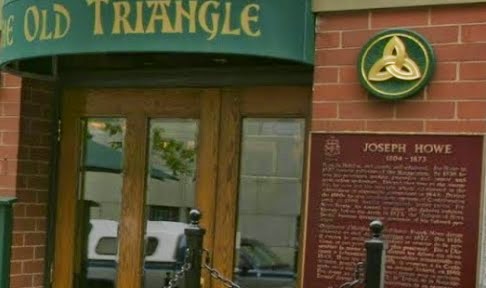
Today I learn that a Halifax watering hole called The Old Triangle is expanding upstairs.  I've never been in, but have it on good authority that this Halifax landmark has three levels inside and a single privy in a cave in the basement.  The ever-reliable Coast calls The Old Triangle 'wheelchair accessible', but they must be referring to the patio on Bedford Row.

This from the Health Protection Act:
Washroom facilities
20 (1) A food establishment must have washroom facilities for staff and washroom facilities for the public available in a convenient location, unless exempted by the Administrator.
(2) A washroom facility must be constructed, equipped, and designed in accordance with the Nova Scotia Building Code.
(3) If an inspector gives written approval, the same washroom facilities may be used for both staff and the public.
The science of pee

“Alcohol is a diuretic,” says Professor Oliver James, head of clinical medical sciences at Newcastle University, where they know their drinking. “It acts on the kidneys to make you pee out much more than you take in – which is why you need to go to the toilet so often when you drink.” In fact for every 1g of alcohol drunk, urine excretion increases by 10ml.

A common side effect of drinking is needing the toilet just five minutes after your last visit. This irritating experience (usually known as 'breaking the seal') happens because alcohol delivers a hefty double whammy to your kidneys.

I freely admit that the patio on Bedford Row is wheelchair accessible.  So here's the question: When I have a beer at The Old Triangle, do I use the washroom across the street at McKelvie's, or do I just pee in the street? 

And another question:  Has the Administrator of the Health Protection Act really exempted The Old Triangle?  Is it forever?  Show me the signature.

***************
Almost there.


Alert readers will know of the plaque affixed to the Prince Street door of The Old Triangle, marking the location of the offices of Joseph Howe's newspaper, The Novascotian.  We all know Howe; among his many accomplishments, he was Speaker of the House of Assembly.  Today's Speaker, The Honourable Kevin Murphy, uses a wheelchair.  His office is 539 feet from the Old Triangle, yet he can't get in.

***************
Finally!


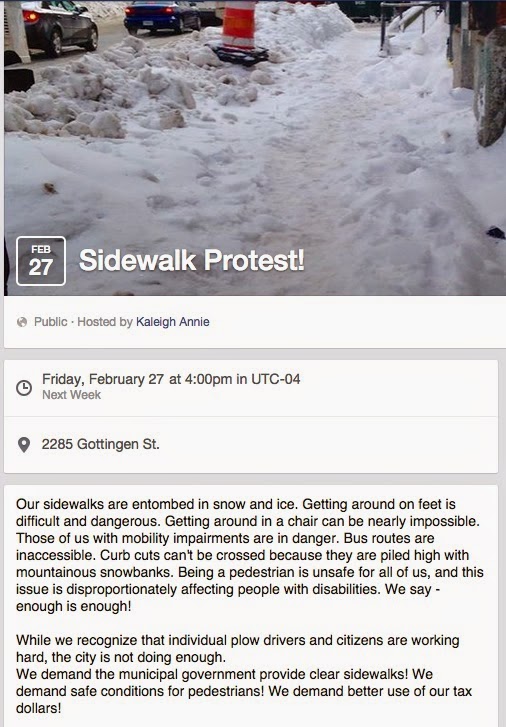
Friday the 27th there is a protest about the state of sidewalks in HRM.  Now the rest of you know what it's like to be captive in a city where the infrastructure is your enemy.   Canada being where it is, snow is a fact of life, but it can be dealt with in an orderly way.  HRM can plow it or residents can shovel it.  Those of you who need a lesson in old-fashioned neighbourliness can ask Paul Vienneau:


The favour could be returned by dealing with accessibility in the same spirit; insisting Paul be made welcome at the Old Triangle, that the Mayor live up to his promises, and someone at Municipal Compliance gets assigned to the catch-up class in accessibility.

Gus Reed