Welcome

...to the website of the James McGregor Stewart Society. We want to change the outlook for people confronting barriers. Please share this site with friends. Your contributions, comments and criticisms will add enthusiasm and vitality.
Please participate by subscribing!
Click here (opens a new window)
Statement of Purpose......... Take Action!......... Become a Member......... Contact
Showing posts with label New Legislation. Show all posts

April 28, 2017

Again, The Building Code

If you can't see a table or chart, click the title above to go directly to the website.
*********
On St. Patrick's day there was an article in Haligonia announcing the April 1 update of the building code.

The article says, in part:
"The province is also updating its own accessibility regulations to improve barrier-free provisions in washrooms, requirements for power door operators and barrier-free paths of travel. 
“Nova Scotia’s accessibility requirements are stricter than the ones in the National Building Code,” said Mr. Churchill. “I want to thank the disability community for their feedback on the building code changes, which will improve barrier-free design in our province.”
The changes will come into effect on April 1. 
The province consulted on building code changes with representatives of persons with disabilities, the construction industry, building officials, and other industry groups. It was a complementary process to the ongoing Accessibility Act consultations. 

I’d like to know the identities of “representatives of persons with disabilities” consulted by the province “on building code changes”. A search of the Department of Municipal Affairs press releases for all of 2016 and 2017 yields no announcement of consultations. Nor the Disabled Persons Commission. As a frequent complainer about the department’s underreach and lax enforcement, I would have a lot to say.

Now I notice that the latest version of the Nova Scotia Building Code Regulations, effective April 1, does not contain all the proposed changes to barrier free requirements listed in the referenced document.  In particular section 3.8.4. Adaptable Housing Requirements is missing entirely. This latter issue is of high interest to those drafting the Accessibility Act, which was passed this week.

I wrote to Joe Rogers, P.Eng. Building Code Coordinator.  He kindly sent me a marked up copy  of the new regulations, so I could identify the changes.  The eighteen changes in Schedules C & D are on these subjects:
  • 3.8.1.1. Scope
  • 3.8.2.6. Controls
  • 3.8.2.8. Plumbing Facilities
  • 3.8.3.1. Design Standards
  • 3.8.3.5. Ramps
  • 3.8.3.6. Doorways and Doors
  • 3.8.3.8. Controls
  • 3.8.3.10. Drinking Fountains
  • 3.8.3.11. Water Closet Stalls
  • 3.8.3.12. Universal Washrooms
  • 3.8.3.13. Water Closets
  • 3.8.3.14. Urinals
  • 3.8.3.15. Lavatories and Mirrors
  • 3.8.3.16. Showers
  • 3.8.3.17. Bathtubs
  • 3.8.3.19. Counters
  • 3.8.3.22. Sleeping Units in Roofed Accommodation
  • Schedule “D” Alternate Compliance Methods for Existing Buildings #15 

I believe these changes are largely technical in nature.  For example, I think there are no new situations when and where a power door must be available, only that it must operate in a certain time interval and with a certain force.  Cars have had seatbelts for years, so to claim that the use of a new fabric is an important safety development is a reach.

These seem like routine updates to me, and to characterize them as "regulations to improve barrier-free provisions" is disingenuous.  Because of numbering changes, it's difficult to itemize the exact changes - 3.8.3.10 used to be urinals, now its drinking fountains.  Be careful........

Taking urinals as an example:

Old VersionNew Version
3.8.3.10. Urinals
(1) If urinals are provided in a barrier-free washroom, at least one urinal shall be
(a) wall mounted, with the rim located between 488 mm and 512 mm above the floor, or
(b) floor mounted, with the rim level with the finished floor.
(See Appendix Note A-3.8.3.10. NSBCR)
(2) The urinal described in Sentence (1) shall have
(a) a clear width of approach of 800 mm centred on the urinal,
(b) no step in front, and
(c) installed on each side a vertically mounted grab bar that is not less than 300 mm long, with its
centreline 1000 mm above the floor, and located not more than 380 mm from the centreline of
the urinal.
3.8.3.14. Urinals
(1) Urinals described in Sentence 3.8.2.8.(6) shall
(a) be wall-mounted, with the opening of the basin located not more than 430 mm above the floor,
(b) be adjacent to an accessible route,
(c) have a clear width of approach of 800 mm centred on the urinal and unobstructed by privacy screens,
(d) have no step in front of it,
(e) have a flush control that
i) is automatic, or
ii) complies with Clause 3.8.3.8.(1)(b) and is located 900 mm to 1100 mm above the floor, and
(f) have a vertically mounted grab bar installed on each side that
i) complies with Article 3.7.2.8.,
ii) is not less than 600 mm long, with its centre line 1 000 mm above the floor, and
iii) is located not more than 380 mm from the centre line of the urinal. (See Appendix A-3.8.3.14., NSBCR)


So urinals are 58 mm lower, have longer grab bars and maybe flush themselves.  A great advance!  People with disabilities are beside themselves with excitement!

The missing section 3.8.4. has to do with adaptable housing and would apply to private dwellings and rentals in respect of:
  • One entrance 900mm wide
  • With a low threshold
  • Interior doors and corridors on the entrance level 900mm wide
  • Lever faucets
  • Reinforced bathroom walls allowing future grab bars
  • One handed controls and switches 400 to 1200 mm high
These ideas are borrowed wholesale from the concept of lifetime homes and are modest concessions to the notion of aging, which comes as a surprise to us all.

Personally, I think this is a no-brainer.  For one's own sake and for resale value.  A young family would easily recoup the expense of these desirable features.  Any semi-conscious builder would see this as a marketing opportunity.   The province has a stake in this too, as people have the option of aging in place rather than in a rest home.

When I pressed Mr. Rogers on why this section was omitted, he said:
With respect to proposed Subsection 3.8.4. here is what transpired.  During the consultation process, the disabled persons’ community, professionals, and organizations brought forward suggestions and concerns with the proposed changes relating to adaptability. For this reason, government opted not to include that piece at this time. This will allow time for further study and consultation to ensure the changes are comprehensive as possible and fully align the Building Code and other legislation. The Building Advisory Committee is committed to bringing changes forward once this research and discussion takes place. 

Make of that what you will.  Find it in the library under the Dewey 823 classification.

As to my original request for the identities of and submissions made by “representatives of persons with disabilities”, Mr. Rogers is thinking:

I will have to look into your request for access to the submissions made by the public with respect to the Freedom of Information and Protection of Privacy Act.  Once the status of those submissions has been determined I will advise.  

I hope those submissions aren't related to National Security.  I'll keep you posted 

June 23, 2015

How employing people with disabilities makes money - Part II

Revised July 22, 2015.

What frosts me most about inaccessible businesses is that a person with a disability could never work in one. For the moment, I don't need the services of the Nova Scotia Legal Information Society, but it's inexcusable that a perfectly qualified person using a wheelchair couldn't get a job there.

Last post, we determined that there are something like 12,641 Nova Scotians with particular disabilities, ages 15 to 64, not currently working who could be.

If they were employed, they'd be paying $18,354,732 in provincial income taxes and saving taxpayers $124,387,440 a year in income support. That's $142,742,172 or $11,292 each. Annually and forever. Pretty soon, you're talking real money.

No one has contacted me with better figures or any objection on principle. So let's start with those numbers.

People with disabilities want to work, be self sufficient and not live in near-poverty. What keeps this from happening is a combination of government policy disincentives and unsuitable workplaces. 

I challenge “Step Up Nova Scotia”, the latest child of the Ivany Report to become "Ramp Up Nova Scotia".  

Let's think of a way to reward people moving from disability support into the workforce, help employers who hire them, and relieve taxpayers whose generosity has supported them. There are any number of ways to do this, so here's my thought. For anyone receiving Services for People with Disabilities who has no employment income, we'll do this once:
  • $500 one time to job applicant for extraordinary expenses 
    • Clothing 
    • Wheelchair seatcover 
    • text-to-speech software for iPhone
    • Transportation 
  • If necessary, $2,000 to employer for new job accommodations related to the particular employee 
    • business Skype 
    • a wheel-under desk 
    • a Braille printer 
    • Screen-reader 
  • If necessary, a $3,000 grant to employer for modifications for public access (can be combined for multiple hires and supplemented with a forgivable loan) 
    • a ramp 
    • accessible toilet 
    • designated parking 
  • $1,500 to employee on first anniversary of hiring 
  • $4,292 savings to taxpayer 
If the employer does not offer supplemental health benefits, including drugs, the province will continue to provide.

There are tremendous benefits to linking accessibility with employment. It's an incentive for employers, taxpayers and job-seekers alike. It has immediate and tangible rewards. It has lasting implications for the general public. It's transparent, voluntary and incremental. It strengthens the case against counterproductive by-laws. It makes accessible transportation a necessity.  It saves a ton of money.

All I'm asking is that this approach gets considered and refined.  It doesn't require up-front appropriations - each participant is self-funding and saves taxpayers over $4,000.  What's the problem with knowing more?  It can't be worse than wasting human capital.

Most of all, it fulfills a promise:

Every individual is equal before and under the law and has the right to the equal protection and equal benefit of the law without discrimination and, in particular, without discrimination based on race, national or ethnic origin, colour, religion, sex, age or mental or physical disability.

June 18, 2015

How employing people with disabilities makes money - Part I

Revised July 22, 2015
Thanks to Sandra McFadyen of the Disabled Persons Commission for sleuthing out some more accurate data.

In March, Stats Canada published a profile of Canadians with disabilities, taken from its 2012 survey of the subject.  Since the data is not disaggregated, at all levels, we need to make some assumptions.

StatsCan says there were 628,310 Nova Scotians ages 15-64 in 2012
89,410 are disabled
44,170 are either unemployed or not in the work force

Now we need to make our guesses.

In the 15-64 age group in Nova Scotia, 53% have physical disabilities routinely accommodated in the workplace - seeing, hearing, mobility, dexterity, flexibility.

Leaving 23,410

In the 15-64 age group in Nova Scotia, disabilities are classified as 

MildModerateSevereVery Severe
32%22%20%26%

Just for the sake of argument, let's focus on the 54% with mild or moderate disabilities.
Leaving 12,641 who could be employed.

Is that a realistic number?  It's about 9% of the total group of Nova Scotians with disabilities, age 15-64.  It sure is a big number that ought to be of concern to business leaders.  It seems to incorporate the correct assumptions.*


With accessible transportation, workplace accommodations, flexible hours, flexible support programs and other means, we'd have a shot at employing those 12,641.

Educational attainment of people with disabilities in Canada is:

  • 18.7% less than high school
  • 25% high school diploma
  • 56.3% postsecondary certificate or diploma
Guessing at income levels, let's figure the provincial income tax from employing those 12,641

PercentNumberIncomeProvincial Income TaxTotal
Less than high school18.70%2364$20,000$1,758$4,155,678
high school25.00%3160$35,000$2,567$8,111,714
postsecondary56.30%7117$50,000$5,618$39,983,289

The total tax revenue is $52,250,681.

Each of those 12,641 is currently receiving supports enabling them to live (the federal/provincial/private breakdown is impossible to parse).  Not fancy, but probably including Pharmacare and other benefits. A per capita expenditure on the order of $15,000 is a reasonable guess.  Let's say that $10,000 is from the province.
That would save  $126,410,000 a year - 40.5% of the $311,735,000 budgeted for the Disability Support Program in the Department of Community Services.  Maybe a bit much, but DCS could name the actual amount.

Making a grand total of $178,660,681.  Going on twice the annual provincial deficit.  Worth the effort.

Now that will certainly take time to realize, but there's clearly money to be made by making the workplace accessible.  Even if the province temporarily used all of the savings and new revenue for incentives, accessibility makes sense for the long term health of Nova Scotia finances.

I'm interested to learn of any corrections or refinements that could be made.  Feel free to email me.

*****************
*Quite different from the 55,000 identified in A Blueprint for Action, The Report of the Nova Scotia Persons with Disabilities Employability Table.  It doesn't show all the steps, but I believe this number includes people aged 65 and older.  It also uses 2006 data from Statscan, which has different definitions.


June 4, 2015

Accessibility Legislation

Yesterday the report to the Minister on accessibility legislation was presented to the public.  Given the number of wheelchairs and white canes, along with American Sign Language translation and speech-to-text facility, you could be forgiven for thinking that this was of interest only to disabled people.

But this is about Nova Scotia.

Nova Scotians face an avalanche of bad news - a shrinking population, a huge debt, rural decline, changes in a resource-based economy, income stagnation - the list goes on.  Nova Scotians are rightly skeptical of policies that seem strangely out of tune with their concerns.  Tuition hikes, higher energy costs, expensive experiments with ferries and convention centers, overcrowded hospitals - another endless list.

Minister Bernard had the best line of the day.  In reply to yet another obtuse question from the press about cost, she said "Of course we worry about the cost of doing this, but we worry more about the cost of not doing it."

That, she explained, is the peril of policies that make it difficult for substantial numbers of Nova Scotians to work, participate in their community, spend money - to lead fulfilling lives.

The second best line went to Speaker Kevin Murphy, wheelchair user, who made the point that his family of four does not shop where he can't shop, go to a hotel without accessible facilities, or go to the restaurant upstairs.  Minister Bernard reminded the audience that the 31 member Liberal caucus does not assemble anywhere Kevin cannot go.

Five Fishermen take note.

22 panel members worked hard to write a visionary document.  It may have started out to be a "Nova Scotians with Disabilities Act", but it became a great deal more.  It's about getting old, being a parent with a stroller, being a little hard of hearing or needing some extra time.

Nova Scotians want a vibrant economy.  How does it further that goal by having buses that smart workers can't use to get to work?

Nova Scotians are so proud of their community.  How can we have a community where people can't use the sidewalks?

If you were paying attention, you heard the words "progressive realization".  This means that the legislation will allow a certain flexibility in meeting goals.  No one wants to upset the conduct of business.  The corner store should not fear that the cost of a ramp will put them out of business.  On the other hand, people should not anticipate that the corner store will remain forever inaccessible.  One way or another, the rights of citizens to a barrier-free province will be achieved.  Panel members were careful to distinguish between "exemptions", which last forever, and "exceptions" which can be granted temporarily.

And just before the coffee and snacks, you heard the words "incentives and penalties".  Panel members urged generous incentives and significant penalties.  The business community will embrace the incentives and may reject the penalties, but the legislation will remind them that they operate for public benefit as well as private gain.

If Hydrostone businessses wants to use publicly provided water, sewer, police and sidewalks, they'll have to live by the rules.

So it was a good day for Nova Scotia.  For once, it seems embarked on a world-class, disruptive endeavor that will be far in advance of other jurisdictions.  The report seems to meet the 200 word requirement outlined earlier.

We'll be watching.


February 22, 2015

A Winter's Tale


This summer I participated in the minister's advisory panel on accessibility legislation. I was co-chair of the committee on the built environment. We submitted our final report to the minister a week ago. 

I'd like to tell you a story.

We met once on September 10 at the Future Inn up near Bayer's Lake, then agreed to meet four successive Mondays as a group. It had been suggested that we should be mindful of the budgetary pressures of the Department of Community Services, so we cast around for a free accessible location (2 in wheelchairs, one with a cane) and were pleased when Paul Pettipas of the Nova Scotia Home Builders Association volunteered his new space at 124 Chain Lake Drive. Complete with state-of-the-art accessible washroom.

Now Paul is a fine advocate (he's a lawyer) for the NSHBA, but a poor judge of accessibility. After the first meeting I was aware of how inaccessible the washroom was, so at the second meeting all twelve of us adjourned to the washroom and examined in detail the shortcomings of the facility. Misplaced mirrors were an inconvenience, misplaced grab-bars around the toilet were a danger.


You can quibble about the details, but the angled grab bar and missing bar over the tank make the toilet unusable. Most importantly, it's not up to code. If the Nova Scotia Homebuilders Association doesn't follow code, why would anyone bother?

Paul offered this plan from HRM, which he evidently followed (except for the angled grab bar).


I suggested that, if I fell while using his substandard grab bars, his insurance company might not be so forgiving, as ignorance is seldom an excuse. Paul was not convinced.

At bottom I know Pettipas is an honourable guy, but based on a string of unhappy experiences beginning with Chickenburger, I am concerned that building inspectors are fundamentally uninformed about accessibility.

 I wrote Jim Donovan, Manager of Municipal Compliance on September 27:
Dear Mr. Donovan,
It's come to my attention that HRM is circulating a template for an accessible washroom that is both at odds with the Province's barrier free requirements and incorrect. I attach a copy.
The conflicts with the building code include
  • rear grab bar requirement (a misinterpreted comma)
  • omitting insulated pipes
  • no mention of controls, like light switches
The reference cited for grab bars - 3.8.3.7(1)(d)(iv) doesn't exist, and points generally to the section on assistive listening devices.
The lack of a rear grab bar is a real problem for wheelchair users, who are explicitly trained in using them for transfer.
I tell you this with the request that it be corrected. In the interest of safety and to protect HRM, it would seem wise to review all permits granted on the basis of this template.
I look forward to hearing from you.
I didn't mention the location.  I had this reply two days later

Mr Reed,
I’m not aware that this document is in circulation but have contacted the Manager of the Permit approvals Section to ensure staff do not propagate its use or content.
It may be that the document was created and used by staff previously as a reference to an earlier, 2006, version of the barrier free regulations is made on its face near the center of the page. Those regulations having been superseded make the entire sheet moot. That being the case I must agree that the content is easily misleading and assure you we both ensure that the document is not in use by our Officials but that the current technical specifications are understood.
Just as a guess, I'd say the Home Builder's occupancy permit is a lot newer than 2006.

************
Bear with me.  Last Fall there was a debate in Council on sidewalk cafes which prompted me to write the Mayor:

Dear Mayor Savage, Mr. Butts and Mr. Labrecque,
I am writing to comment on the proposed changes to the Sidewalk Cafe Bylaw outlined in the staff report of September 8, 2014.

You will be aware that the Healthy Communities Initiative, passed unanimously by Council, includes the following commitment: “HRM is a leader in building an inclusive and accessible community for everyone, including persons with disabilities and seniors”
HRM staff often prevent the installation of wheelchair ramps at retail establishments because they would encroach on city property. Yet the report on sidewalk cafe regulation proposes to allow much greater encroachment on city property in the interests of permitting sidewalk cafes.
The staff report spends a fair amount of time on accessibility, but fails to consider the broader implications of fairness and the true meaning of accessibility.  For example, many of these sidewalk cafes serve otherwise inaccessible restaurants. What good is an accessible cafe at a restaurant where a customer can't use the washroom?
The sidewalk cafe bylaw changes present a great opportunity to use the power of the city to advance your 'healthy communities' agenda.  Specifically, you should refuse to license any sidewalk cafe unless the restaurant sponsoring it provides on-premises access to a barrier free washroom.

Without such a provision, council would effectively be trading my interest in the public sidewalk for a facility that discriminates against me.
I would go further: No cafe for restaurants that don't offer equivalent experiences to all diners.
  • Is there an upstairs service different from downstairs? 
  • A sports bar upstairs and none downstairs? 
  • An Oyster Bar downstairs, but a full-service restaurant upstairs?
Restaurants must be equitable in their offerings, giving equivalent service and experience to all diners. They don't have to magically transport me to the second floor, but all dining experiences must be available to all customers.

Otherwise, no cafe.
This is a power HRM clearly has; to put meaningful action behind the brave words of the Healthy Communities Initiative.  I have other commitments tomorrow, but I would like this email to become part of the record on this matter. Can I please ask that it be read in Council?
Best regards,

Warren Reed
cc. Shaune MacKinlay, Waye Mason

I did not hear back.

****************
Bear with me.

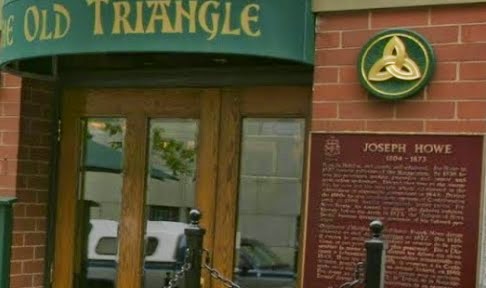
Today I learn that a Halifax watering hole called The Old Triangle is expanding upstairs.  I've never been in, but have it on good authority that this Halifax landmark has three levels inside and a single privy in a cave in the basement.  The ever-reliable Coast calls The Old Triangle 'wheelchair accessible', but they must be referring to the patio on Bedford Row.

This from the Health Protection Act:
Washroom facilities
20 (1) A food establishment must have washroom facilities for staff and washroom facilities for the public available in a convenient location, unless exempted by the Administrator.
(2) A washroom facility must be constructed, equipped, and designed in accordance with the Nova Scotia Building Code.
(3) If an inspector gives written approval, the same washroom facilities may be used for both staff and the public.
The science of pee

“Alcohol is a diuretic,” says Professor Oliver James, head of clinical medical sciences at Newcastle University, where they know their drinking. “It acts on the kidneys to make you pee out much more than you take in – which is why you need to go to the toilet so often when you drink.” In fact for every 1g of alcohol drunk, urine excretion increases by 10ml.

A common side effect of drinking is needing the toilet just five minutes after your last visit. This irritating experience (usually known as 'breaking the seal') happens because alcohol delivers a hefty double whammy to your kidneys.

I freely admit that the patio on Bedford Row is wheelchair accessible.  So here's the question: When I have a beer at The Old Triangle, do I use the washroom across the street at McKelvie's, or do I just pee in the street? 

And another question:  Has the Administrator of the Health Protection Act really exempted The Old Triangle?  Is it forever?  Show me the signature.

***************
Almost there.


Alert readers will know of the plaque affixed to the Prince Street door of The Old Triangle, marking the location of the offices of Joseph Howe's newspaper, The Novascotian.  We all know Howe; among his many accomplishments, he was Speaker of the House of Assembly.  Today's Speaker, The Honourable Kevin Murphy, uses a wheelchair.  His office is 539 feet from the Old Triangle, yet he can't get in.

***************
Finally!


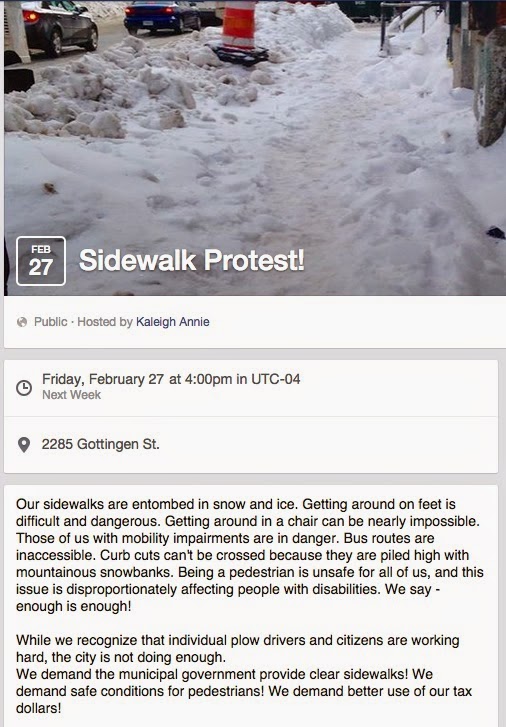
Friday the 27th there is a protest about the state of sidewalks in HRM.  Now the rest of you know what it's like to be captive in a city where the infrastructure is your enemy.   Canada being where it is, snow is a fact of life, but it can be dealt with in an orderly way.  HRM can plow it or residents can shovel it.  Those of you who need a lesson in old-fashioned neighbourliness can ask Paul Vienneau:


The favour could be returned by dealing with accessibility in the same spirit; insisting Paul be made welcome at the Old Triangle, that the Mayor live up to his promises, and someone at Municipal Compliance gets assigned to the catch-up class in accessibility.

Gus Reed

January 24, 2015

Ontario


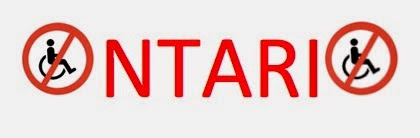
MORE THAN VOTING BOOTHS: ACCESSIBILITY OF ELECTORAL CAMPAIGNS FOR PEOPLE WITH DISABILITIES IN ONTARIO is a long article from Ontario about the rather sorry state of accessibility at campaign offices.

The page, on the website of the 

ACCESSIBILITY FOR ONTARIANS WITH DISABILITIES ACT (AODA) Note: This is NOT a Government run Site!!.

reminds everyone of the ineffectiveness of the Ontario Legislation:

The AODA Clock is Ticking
There are 9 years, 49 weeks, 1 day till a fully Accessible Ontario! Will you be compliant?

This timetable, seemingly based on the end of the world scenario, when asteroid Apophis collides with Earth in 2029, promises four years of accessibility before everyone is blown to smithereens.  

In the lengthy article, no reference is made to Nova Scotia's pioneering requirement that MLA offices be accessible (since 2013, mind you).

Nor do those Ford voters seem to grasp that not being able to get into such an office means a person with a wheelchair could never ever be employed there.  

Of course bodily functions are not a consideration in Ontario, but here in Nova Scotia we treasure our right to pee in constituency offices, where accessible washrooms are mandated.

If I lived in Ontario (shoot me!), the glacial pace of accessibility reform  would drive me crazy.  It's demeaning, counterproductive and just plain cowardly.

As we lead up to our own accessibility legislation in Nova Scotia, let's remind ourselves that the best example is right here at home.  MLA constituency offices must be accessible.

Gus Reed

ps for the not-faint-of-heart, here's more on the failure of The AODA:

PREMIER WYNNE AND ECONOMIC DEVELOP MINISTER DUGUID RESPOND TO AODA ALLIANCES DETAIL PROPOSALS TO GET ONTARIO BACK ON SCHEDULE FOR FULL DISABILITY ACCESSIBILITY BY 2025

and it just gets worse (sorry for the ads):

January 13, 2015

Selma


I'm reluctant to compare the situation of people with disabilities with the struggle for civil rights by black folks, mostly because the colour barrier is drawn with such hatred and malice, whereas the ability barrier is drawn with ignorance.

There isn't a white guy with a club preventing me from going in the front door of city hall; just many years of neglect, misaligned priorities, laziness and invisibility.

Nevertheless, the effect is the same.  By almost any measure - employment, income, participation, education, health - people with disabilities are second-class Canadians.

If you go to see Selma, which I urge you to do, pay attention to the dynamic between Martin Luther King, Jr. and President Johnson.  I saw an interview with director Ava DuVernay, who said she used considerable artistic license in her portrayal of Johnson.

She contrasts King's campaign for equal rights with Johnson's notion of the Great Society.  In King's vision, people are lifted up by an idea.  In the Great Society, segregation will disappear as income, employment and education improve.  I guess we'll never know for certain about the Great Society, but from the ruins of Jim Crow arose a black president.

Personally, I think there's room for both views, as long as equality comes first.  The US Constitution and Canadian Charter both promise it; that is literally the social contract.  Having acknowledged equality of opportunity, I think we have an obligation to see it made tangible through education, employment and participation.  People of good will can differ on the subject of how government influences outcomes, but we need to operate by the same rules.

I encourage those in the Nova Scotia government who are wrestling with the promised Accessibility Legislation to focus laser-like on equal rights and opportunities.  Equal outcomes may emerge in time, but government can best fulfill its role by keeping its constitutional promise.

Every individual is equal before and under the law and has the right to the equal protection and equal benefit of the law without discrimination and, in particular, without discrimination based on race, national or ethnic origin, colour, religion, sex, age or mental or physical disability.

By confusing equal opportunity and equal outcome, Ontario and Manitoba have gotten it wrong and BC has completely deluded itself.  Nova Scotia can do better.

November 17, 2014

Accessibility Legislation in under 200 words

Most people hear the words "accessibility legislation" and think of a wheelchair.   Unquestionably, people with disabilities need access, but so does the FedEx person, the mom with a stroller, the tourist from Boston, and your aging parent.  Those people use the access, but they don't think twice about it.

People with disabilities are willing to share the curb cuts with the FedEx person and don't mind when the home handyperson, laden with building supplies, pushes the power door button at Rona.

Change is coming, so instead of complaining about the cost, lets get ready!  All those baby boomers in Toronto who just turned 65 won't settle for the inconvenient bathtubs at the Wandlyn.  Those dads with kids in strollers won't be happy changing a diaper in the tiny washroom downstairs.  That nice young couple asking about a new house with a ground floor bedroom for the visiting parents are the future.  Accessibility is where it's at. and good businesspeople will recognize it.

Here is the rationale and a simple design for accessibility legislation in under 200 words:

Why

These three simple and important messages bear repeating:
  1. It's good for citizens
    1. We're all getting older
    2. Many accessible amenities are just better ideas that everyone takes advantage of
      1. Level entrances
      2. Low-floor buses
      3. Curb cuts
      4. Family washrooms
    3. Nova Scotia is emptying out - we need to match our priorities with our people and rely on ourselves
  2. It's good for business
    1. There is a huge and growing demand for accessible tourism 
    2. With housing starts down considerably in Nova Scotia, builders need to turn their attention elsewhere
    3. More access means more retail customers
  3. It's good for government, whose highest purpose is the equal treatment of all citizens
    1. More jobs mean more taxes and less costly support of the presently hard-to-employ
    2. Ditto more economic activity 
    3. More aging at home means less expensive alternatives to nursing homes.
    4. Safer infrastructure means reduced healthcare costs

How & When

These are the components of good legislation:
  1. Standards
    1. Independently defined
    2. Exceptions allowed
    3. Exemptions not considered
  2. Enforcement is the responsibility of government
  3. Meaningful Penalties
  4. Incentives
  5. Swiftly accomplished

Where

Covering public and private activities in these domains
  1. The built environment
    1. for private dwellings, incentives, not penalties
  2. Employment
  3. Transportation
  4. Information
  5. Services

November 12, 2014

Getting Old

As an official 65 year-old, I'm entitled to ramble on a bit.  In today's Chronicle Herald is one argument for accessibility legislation.  Here's another, coincidentally supported by a lead story on home-care and nursing homes (a term pretty much out of fashion):

As you know, the Province of Nova Scotia is poised to introduce Accessibility Legislation and it has embarked on a program of soliciting public input.  Even I admit this doesn't sound very exciting, and the vast majority of Nova Scotians would not be expected to have an opinion one way or another.

Except that, one way or another, we all stand to gain.  Especially us senior citizens, hoping to live out our lives in one piece.  There are components of this legislation that matter less to seniors, like employment, but accessibility for people using wheelchairs is indistinguishable from accessibility for people using walkers or people who are going a bit slow this morning, thank you very much.  Low-floor buses and decent transportation are just as important in keeping us retirees engaged in the community as to getting you worker bees to your job.

Being a weather chicken, in the winter I live in a place called Fearrington Village in North Carolina. Business Week thinks it's got its share of interesting folks.  It's not quite the anteroom of eternity, but it's a stop along the way.  The average age is 73.  I think it's about evenly divided between people who want to 'age in place' and those who expect to move to 'continuing care', as it's more fashionably called.

Doesn't look like Lynne.  Looks like me, but isn't.  
At least at the beginning, aging in place is possible because the infrastructure here is largely accessible, thanks to the Americans with Disabilities Act.  It's not magic, but there's a reasonable expectation that a business, sidewalk or service will be accessible and safe. Later on, if there are decent home care alternatives and you have a house that isn't your enemy, you can stay independent.

The government has a stake in this because it's far cheaper to provide in-home services than to pay for beds in continuing care facilities.   And far better to provide safe infrastructure than to clean up the mess.

They say that disability touches us all - we have a relative with a disability or an aging parent.  But it gets even more personal when you wake up one day and discover you're not 19 anymore.  As evidence that we're not as spry as we used to be, consider that in 2011 3,232 Nova Scotians had a knee or hip replaced, up 42% from 2,268 five years before.  A total of 13,773 in five years.

The New York Times just had a sobering two part series on the hazards and consequences of falls. Nova Scotians who have had intimations of their own mortality should pay attention and applaud the development of accessibility standards.

If things go well for you, accessibility will be important in your sunset years.  If you are so inclined, you can visit the website of Nova Scotia's public consultation process and make a comment.  The public meetings run from November 13 to December 3.  If you don't care about the gory details, you can just write a sentence or two in the Other Comments section,  saying you are a senior or aspiring senior who expects the government to be proactive, timely and decisive.

And it never hurts to let your MLA know.  Send me a copy!

Gus Reed
wcreedh@gmail.com


September 25, 2014

Lives Worth Living

There is a moving and uplifting PBS documentary Lives Worth Living which chronicles the events leading to the enactment of the Americans With Disabilities Act. in 1990.  Here is a 14 minute excerpt, focusing on the politics, personalities and final outcomes.  The full DVD is expensive, but may be available at your local library.


24 years on, Nova Scotia badly needs to step up with similar Civil Rights legislation, and indeed has promised to do so.

July 1, 2014

Canada Day, Democracy and Purpose


Last fall, the Liberal Party campaigned on this issue:

  • Create a more accessible Nova Scotia for persons with disabilities by appointing an Accessibility Advisory Committee with a mandate and strict timeline to develop accessibility legislation for Nova Scotia.
This effort got underway last Tuesday, announced as follows:

Panel Will Help Make Province More Accessible, Inclusive

Department of Community Services

June 24, 2014 12:08 PM

Government is acting on its promise to make Nova Scotia a more accessible and inclusive place to live and work by creating the Minister's Advisory Panel on Accessibility Legislation.

"Government made a commitment to create new legislation that will make the province more accessible and inclusive for persons with disabilities," said Community Services Minister Joanne Bernard.

"This panel brings together a diverse group with experience and expertise that will make sure our legislation delivers on that commitment and ensures all Nova Scotians have equal opportunity to reach their potential." 

In the interest of full disclosure, I should reveal that I am one of 20 or so members of this panel. I have high hopes.

Perhaps we can pause this Canada Day to remember that accessibility legislation honors the spirit of the nation as much as the parades and fireworks. This important work is the fulfillment of a promise made to all.  This legislation will say more about Nova Scotia than about people with disabilities.

Langston Hughes, an American poet, would probably forgive me for paraphrasing his poem:

I, too, sing O Canada.
I am the different brother.
They feed me crumbs in the kitchen
When company comes,
But I laugh,
And eat well,
And grow strong.
Tomorrow,
I'll be at the table
When company comes.
Nobody'll dare
Say to me,
"No room at the table for you,"
Then.
Besides,
They'll see how capable I am
And be amazed--
I, too, am Nova Scotian.

And, since I am borrowing from others, here is a repurposed paragraph from Drew Faust's letter about the poem.

It is time for us to ensure the fundamental justice that guarantees every member of this community an honored seat at the welcome table. Every group that makes up this richly diverse province must feel confident in affirming, “We, Too, are Nova Scotians.” We are at once many people, one people. That is our strength.


Gus Reed

April 13, 2014

Equal Opportunity for Nova Scotians – Interim Report

Here is the Introduction.  Read the complete report here. 

Introduction

The new Liberal government of Nova Scotia has promised to enact legislation to address the circumstances of people with living with disabilities. ProBono student volunteers at Dalhousie law school have been working with the James McGregor Stewart Society to outline legislation to be enacted in Nova Scotia. The purpose of the draft is to ensure the government is provided with context, information and background when addressing the situation of people who are prevented from the full enjoyment of society. In our research, we have come to realize that this is not just a human rights issue but a civil rights issue as well. In the best sense, this is about fulfilling the promise of the Charter of Rights and Freedoms for all Nova Scotians.

Our overarching goal was to determine a way to offset individual differences with accommodations, and to make that a requirement of the legislation. Abilities do vary, but they should not be defined by intentional or accidental barriers.

We examined the Access for Ontarians with Disabilities Act, in particular the 5 year review mandated in 2005, and the Americans with Disabilities Act.  They are summarized below.  We tried to account for the complexities of The UN Convention on the Rights of Persons with Disabilities and to reconcile our efforts with some of its obligations.

We kept a log of important concepts in the form of Principles.  Three fundamental requirements quickly emerged:
  •  Written standards for infrastructure and process
  •  Enforcement by government
  • Application to private and public entities

Our draft legislation, in narrative form, which we have called the Equal Opportunity for Nova Scotians Act, follows the summary of our research.  The Act is intended to create standards, and to hold the provincial government accountable for the commitment they made. The Act covers employment, transportation, accommodation, communications and the provision of goods and services.

Following the draft act is a summary of an on-line survey we administered.  We circulated it to about 150 people, generally activists and got about a 50% response.  The summary is based on the first 65 responses.  Generally, the priorities expressed in the survey are consistent with our vision of the legislation.  It is important to note that there is an undercurrent (not always well hidden) of frustration with government, especially among those who identify themselves as disabled. 

For ease of understanding, we use  the word “disabled” in a conventional sense.  We do so reluctantly, because it implies that a person has some condition that prevents participation.  Almost always, exclusion results from a barrier, intentional or accidental.  Perhaps the new legislation can help us understand that we are all different and stand to benefit equally from removing barriers.

Important as a piece of legislation may be, any law cannot succeed without the commitment of the government, organizations, businesses, and community members.  Attitudes towards any marginalized person in our province are transmitted through various bodies and individuals. When the leaders in our community project an attitude that highlights the importance of equality and encourages accommodations, that attitude will become pervasive in all aspects of our community.

If you wish to provide feedback on this draft, please email the James McGregor Stewart Society at wcreedh@gmail.com.

- Gus Reed, Kelsey Evaniew, Ben Corkum & Lisa Wagner

Kelsey Evaniew is in her third year of law school. When she is not in the library, she can usually be found in one of Halifax's many cafes, reading.  

Lisa Wagner graduated from the Schulich School of Law in 2012 and completed her articles in Vancouver. She transferred to Nova Scotia in 2014 and she currently practices personal injury law.

Gus Reed is the co-founder of the James McGregor Stewart Society

Ben Corkum is in his second year of law school with a passion for studying criminal law, mental health problems and the fine arts


Pro Bono Dalhousie is the organization through which most law students first connect to the broader Halifax community. Pro Bono Dal is the local chapter of Pro Bono Students Canada (PBSC), a nation-wide program that serves as an access to justice initiative providing legal services without charge to organizations that cannot afford independent legal advice. PBSC has chapters at all 22 law schools in Canada. Each year, PBSC provides 1400-1500 law students with volunteer opportunities to connect with their local community, and develop their legal skills, by working with lawyer supervisors and up to 400 organizations coast to coast.

March 12, 2014

Be heard!

If you haven't already done so, please take a few minutes to complete this survey on upcoming legislation.  Just 25 responses so far - we can do better!