Welcome

...to the website of the James McGregor Stewart Society. We want to change the outlook for people confronting barriers. Please share this site with friends. Your contributions, comments and criticisms will add enthusiasm and vitality.
Please participate by subscribing!
Click here (opens a new window)
Statement of Purpose......... Take Action!......... Become a Member......... Contact
Showing posts with label Research. Show all posts

July 14, 2015

Improving on Nova Scotia Business, Inc.

Laurel Broten, president and CEO, at Nova Scotia Business Inc. said in the Chronicle-Herald that a year of talks with the Royal Bank produced the following deal:

NSBI will provide payroll rebates of $22,000,000 over 10 years if RBC's new cheque processing centre produces 500 new jobs.
Here's the math:
$22,000,000 / 500 / 10 = $4,400/job/year

If RBC creates 500 new jobs in the next 10 years, the company would add an estimated $240 million in salaries and benefits to the Nova Scotia economy, according to Nova Scotia Business Inc.
Here's the math:
$240,000,000 / 500 /10 = $48,000 average salary (this depends a little on how fast jobs are added and the nature of benefits, but it's a useable estimate).  
Annual provincial income tax on $48000 = $4608
Net gain to province = 10 yrs * ($4608 - $4400) =$2,080
$2,080 * 500 employees = $1,040,000

Here's some more math:
Broten's salary is $210,000/year, so over the life of the Royal Bank deal. we'll be paying her $2,100,000 - a little more than twice the savings to taxpayers.  Not much of a deal for us, eh?

Contrast that with my plan for incentives to employ workers with disabilities receiving assistance, which nets $14,133 per job in new revenues and program savings.  Depending on how you spend that, it's something less.  I was thinking $7,133 in savings was a nice round number.

Oh, and that's ANNUALLY, so $71,330 per job.  A lot more if you only incentivise the first year.
Here's the math:
Net gain for Laurel / Gus' net gain for each new disabled worker = How many disabled workers you'd need to hire to be better than Broten's deal with Royal Bank.
$1,040,000 / $71,330 = 14.58
Hiring 15 Nova Scotians with disabilities is a better deal than hiring 500 Royal Bankers.  People with disabilities would say this is obvious.

I freely admit that my plan does not create NEW jobs, but because it eliminates large government expenses and doesn't involve subsidies, each new hire has a much bigger impact. 

Like Broten's plan, there is little risk:
We prefer this arrangement because no rebate money is paid unless and until a company first meets employment and salary targets. This guarantees that we have a positive return on investment (ROI). In other words, Nova Scotia gets paid first.
Unlike Broten's plan, mine estimates a 10 year return of over a billion dollars.  Roughly 1000 times better.  And it is completely scalable - it works for 10 or 100 or 1,000 or 10,000.

My estimates rely on my interpretation of aggregate data.  The actual numbers are not available to mere taxpayers, but Laurel would have them.  I've been wrong before, but never by a factor of 1000.  If Broten is interested in real savings, real change and real innovation, she should take a look.

I know this is threatening to vested interests.  As an experiment, let's try it out on 15 people without delay.

Gus Reed

PS  James McGregor Stewart, after whom this society is named, was a director of the Royal Bank.  He saved their bacon on many occasions, proving that a person with a disability can be useful as well as ornamental.....

October 12, 2014

Best Cities for Canadians with Disabilities

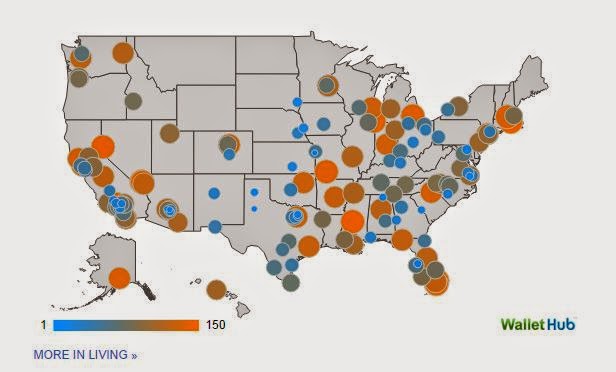
You may have seen this map, which looks like where Canadians go after Christmas, but in fact is something quite different.

And the article:

Ranking Names Best Cities For People With Disabilities

The US survey considers 23 variables.  Can we do something simpler for Canada?  Here's what I came up with.  A bit of a dog's breakfast of data, but probably not far off:

  • Population:  Bigger is surely better, with more access to jobs and teaching hospitals
  • Population Density:  Compactness means services are handier, transportation networks closer
  • Provincial Disability Rates:  If people with disabilities are already there, services must already be in place
  • Seniors:  Ditto people over 65
  • Receiving Adequate Care: Ditto
  • Cost of Living:  Cheaper is better (2002 = 100)
  • Income Gap - difference between median incomes for people with disabilities and median family incomes for CMAs - smaller is better, but Wow! Look at those numbers!

CMAs are ranked on the 7 variables, ranks are averaged, and then ranked again.  So all variables are given equal weight

Most of the variables in the US survey are at least indirectly accounted for except:

  • Climate - This is Canada.  Geez.
  • Health insurance - ditto


Here's the map, dozen best in green, dozen worst in red.  Vancouver is best.  Halifax, where I live is tied for 8th.  Edmonton is worst.


And a table to play with.  Click a header to sort.

Here are the data sources:


April 13, 2014

Equal Opportunity for Nova Scotians – Interim Report

Here is the Introduction.  Read the complete report here. 

Introduction

The new Liberal government of Nova Scotia has promised to enact legislation to address the circumstances of people with living with disabilities. ProBono student volunteers at Dalhousie law school have been working with the James McGregor Stewart Society to outline legislation to be enacted in Nova Scotia. The purpose of the draft is to ensure the government is provided with context, information and background when addressing the situation of people who are prevented from the full enjoyment of society. In our research, we have come to realize that this is not just a human rights issue but a civil rights issue as well. In the best sense, this is about fulfilling the promise of the Charter of Rights and Freedoms for all Nova Scotians.

Our overarching goal was to determine a way to offset individual differences with accommodations, and to make that a requirement of the legislation. Abilities do vary, but they should not be defined by intentional or accidental barriers.

We examined the Access for Ontarians with Disabilities Act, in particular the 5 year review mandated in 2005, and the Americans with Disabilities Act.  They are summarized below.  We tried to account for the complexities of The UN Convention on the Rights of Persons with Disabilities and to reconcile our efforts with some of its obligations.

We kept a log of important concepts in the form of Principles.  Three fundamental requirements quickly emerged:
  •  Written standards for infrastructure and process
  •  Enforcement by government
  • Application to private and public entities

Our draft legislation, in narrative form, which we have called the Equal Opportunity for Nova Scotians Act, follows the summary of our research.  The Act is intended to create standards, and to hold the provincial government accountable for the commitment they made. The Act covers employment, transportation, accommodation, communications and the provision of goods and services.

Following the draft act is a summary of an on-line survey we administered.  We circulated it to about 150 people, generally activists and got about a 50% response.  The summary is based on the first 65 responses.  Generally, the priorities expressed in the survey are consistent with our vision of the legislation.  It is important to note that there is an undercurrent (not always well hidden) of frustration with government, especially among those who identify themselves as disabled. 

For ease of understanding, we use  the word “disabled” in a conventional sense.  We do so reluctantly, because it implies that a person has some condition that prevents participation.  Almost always, exclusion results from a barrier, intentional or accidental.  Perhaps the new legislation can help us understand that we are all different and stand to benefit equally from removing barriers.

Important as a piece of legislation may be, any law cannot succeed without the commitment of the government, organizations, businesses, and community members.  Attitudes towards any marginalized person in our province are transmitted through various bodies and individuals. When the leaders in our community project an attitude that highlights the importance of equality and encourages accommodations, that attitude will become pervasive in all aspects of our community.

If you wish to provide feedback on this draft, please email the James McGregor Stewart Society at wcreedh@gmail.com.

- Gus Reed, Kelsey Evaniew, Ben Corkum & Lisa Wagner

Kelsey Evaniew is in her third year of law school. When she is not in the library, she can usually be found in one of Halifax's many cafes, reading.  

Lisa Wagner graduated from the Schulich School of Law in 2012 and completed her articles in Vancouver. She transferred to Nova Scotia in 2014 and she currently practices personal injury law.

Gus Reed is the co-founder of the James McGregor Stewart Society

Ben Corkum is in his second year of law school with a passion for studying criminal law, mental health problems and the fine arts


Pro Bono Dalhousie is the organization through which most law students first connect to the broader Halifax community. Pro Bono Dal is the local chapter of Pro Bono Students Canada (PBSC), a nation-wide program that serves as an access to justice initiative providing legal services without charge to organizations that cannot afford independent legal advice. PBSC has chapters at all 22 law schools in Canada. Each year, PBSC provides 1400-1500 law students with volunteer opportunities to connect with their local community, and develop their legal skills, by working with lawyer supervisors and up to 400 organizations coast to coast.

December 20, 2013

Quebecward-ho!


Statistics Canada just published the results of the 2012 Canadian Survey on Disability, the descendant of the Participation and Activity Limitation Surveys of 2001 and 2006.

You will be forgiven if you think it's just a catalogue of Canada's aches and pains.  It is a dreary report, containing the rather alarming conclusion that "An estimated 3.8 million adult Canadians reported being limited in their daily activities due to a disability in 2012. This represents 13.7% of the adult population."

That isn't strictly true.  3.8 million Canadians did in fact report being limited in their daily activities, but Statistics Canada attributes the cause to 'disability' rather than 'my bad back' or 'those damned bifocals'.  Doubtless there is a trove of useful information hidden in the heaps of data accumulated by the 350 question survey, (if you finish the survey,  you don't have ADHD), but it isn't contained in the trivial assemblage of the Statistics Canada report.

The survey has sections on transportation, employment discrimination, workplace accommodation, education, independence and technology which could document the situation of people with disabilities and suggest ways forward.  Instead we get an uncritical and unimaginative inventory of symptoms.

From this report, followers of evidence-based practice will instantly move to Quebec.


The blue bars above are percent of population, and the red line represents the excess or shortfall based on the national average.    So Quebec has around 266,568 fewer adults with "disabilities" than you would expect if it was the same as all of Canada.  Ontario has 179,484 more.  Nova Scotia has 38,769 more.  


Over half of the limitations are mild or moderate.

This paragraph from the report is misleading:

Prevalence rises with age

The prevalence of disability increases steadily with age: 2.3 million working-age Canadians (15 to 64), or 10.1%, reported having a disability in 2012, compared to 33.2% of Canadian seniors—those aged 65 or older. Within the working-age population, those reporting a disability was 4.4% for people aged 15 to 24, 6.5% for those 25 to 44 and 16.1% for those 45 to 64. This proportion reaches 26.3% for those aged 65 to 74 and 42.5% among those 75 and older.
As this chart shows, while the proportion of "disability" rises with age, the largest number is contained in the 45-64 age group:


More to come.

June 1, 2013

The price of democracy: $177.25/mo

Yesterday, the House of Assembly Management Committee, which sets the rules for MLA expenses, passed up an opportunity to affirm democratic rights for up to 28,000* Nova Scotians who use wheelchairs.  

The HAMC was presented with a plan for requiring constituency offices to meet the barrier-free standards of the province's own building code.  Timed to coincide with the upcoming election and the expected large turnover, the proposal also made the case for renovating existing offices, with landlords recapturing the costs in increased rent.

Alas, the price of democracy was too high for the HAMC, which decided further study was needed.

Chris d'Entremont, Progressive Conservative MLA for Argyle, says he has been searching for accessible office space for 10 years.  He pays $1,182.44 a month to rent his constituency office, which has a gravel driveway, a step at the entrance and no accessible washroom.  Becky Kent, Cole Harbour/Eastern Passage pays $1,130.44 for slightly more accessible space.

In ten years, that totals $141,892.80 transferred from the taxpayer to Vaughne Holdings, d'Entremont's landlord.  A tidy and reliable income.

Assuming $69.99 for a portable ramp is too much of an expense for d'Entremont, let's do a hypothetical.  I don't have a picture, but let's figure he has 3 steps for a total of 20 inches.  That would require a 20 foot ramp.  Here's a spiffy one for $1682.00 US.

For an accessible bathroom renovation Fixr.com reports:
  • To do a bathroom "update" which replaces the tub, toilet, vanity, and flooring would cost approximately $9,020. 
  • This pricing structure assumes that carpenters charge an average of $70 per hour, electricians between $65 to $85 per hour, and plumbers between $45 and $65 per hour.  (Hmmm)
d'Entremont doesn't need the bathtub, but we'll let him have it.  36" doors are a must.  One outside door, and one inside for the washroom.  This handy guide says they can be done for under $1000 each.  

2" asphalt paving is $1.80/sq ft.  Guessing the driveway is 100' long and 15' wide, that's $2700.

So the total cost of democracy is $15,402.  At a usurious 6.8% a ten year loan will run $177.25 a month, with cumulative payment of $21.269.44

Who should bear that expense?  The landlord?  So Vaughne Holdings would get $120,622.56, some writeoffs, an accessible space, and a 10 year tenant.  They'd be dumb not to do it.

The taxpayer?  In the last six months we paid d'Entremont's cell phone bill, averaging $229.16, most of which immediately leaves the province.  The $177.25 would mostly stay in Tusket and serve the good people there.  Taxpayers can afford it, landlords can afford it - just make a rule, willya?

By the way, since d'Entremont lives so far away, he gets $1285/mo to rent an apartment at Garrison Watch.  We taxpayers pay for that because we want him to do a good job representing his constituents.  You'd think it might be worth a tenth that amount to get to know all his constituents.

Chris!  We're generous to you, be generous to us.

Gus Reed

*based on a 2006 survey by Statistics Canada

February 8, 2013

Off The Radar


Using Google Trends one can get a sense of where Nova Scotia fits in awareness of Disability Rights.  Worldwide, New Zealand is the place where it's a hot topic - Kiwis get 100.  The 100 considers the total search traffic for each area and is assigned to the location with the highest likelihood that any search will be for 'disability rights'.  Hovering your mouse over Great Britain shows 67, meaning that any search in GB is two-thirds as likely to be for 'disability rights' as in New Zealand.  It's a measure of relative popularity.   46 in the US, 23 in Canada.

Limiting the area of interest to Canada, we find Ontario with 100, BC with 61 and the rest zero.  So in Canada, the highest likelihood of searching for 'disability rights' is in Ontario, and in BC it's 61% as likely compared to Ontario.

If you look in Nova Scotia alone you get this message:
Not enough search volume to show graphs.
To get a sense of how the topic of disability rights compares with a similar topic in Canada, we can add another term.  'charter rights' is 23 times more likely to be searched than 'disability rights'.  This time, Alberta gets 100 (surprise!) but Nova Scotia has a respectable 59.

Looking for something that truly matters, check out 'hockey' (worldwide, Canada = 100), which has a strong showing in every Province and Territory - Nunavut dominates with 100, Nova Scotia is 67.  By comparison, 'disability rights' creates nary a ripple.
Nothing really surprising here, except confirmation that it's up to us to make ourselves heard.  It's interesting that in a province with a Disabled Persons Commission in a country that signed and ratified the UN Convention on the Rights of Persons with Disabilities there is little interest in the subject.  Disability Rights are not a Google Trend in Canada.

The takeaway here is that language matters.  Everyone has Charter Rights but only people with disabilities have disability rights.  To the degree that the UN Convention allows 'disability rights' to be considered separately, it permits a distinction that is ultimately harmful to the cause.

October 26, 2012

Incarceration of Information


Are you dying to find the latest annual report of the Nova Scotia Disabled Person's Commission (DPC)?  Look no further than the Disabled Persons Commission Annual Report 2002-2003.  Although Canada signed the UN Convention on Persons with Disabilities on March 11, 2010, it's still 3 years in the future for the DPC.

These 5 to 9 year old reports are among the most current documents on the website of the Nova Scotia Disabled Persons Commission, which today (October 26, 2012) proudly announces


I received a response on July 12, which is reproduced in full here, and contains details of:
  • efforts to increase the commission’s staff, to create a Disability Strategy for the province and to redesign the website to be fully accessible.
  • A new and fully accessible website currently in the testing stage with the expectation that it will be rolled out by early Fall. 
  • Links to 3 additional statistical reports, published in 2009 and 2010, all reviewing 2006 data 
  • A list of current Commissioners
  • Caution that many of the issues are complex and progress can be incremental. 
  • And concluding with pride
    • "I’m proud of our work and look forward to an expanding role for the commission as we embark on developing the Disability Framework." 
Nice, but not exactly the flood of pent-up information I was looking for.

So with my friend and fellow blogger Parker Donham, I filed a Freedom of Information Request on July 16, asking for the minutes of the Minister's Steering Committee meetings (twice a year for ten years) and the draft Disability Strategy and Disability Framework (whatever that is).


Not having heard by August 16, I inquired and learned there was no record of my request.  Should I have spent $10 to send registered mail?  


  • So the 30 days for the DPC to respond actually started running August 16.
  • September 16, a 30 day extension is sought 
  • October 18, another 30 day extension, granted by the Freedom of Information Review Officer without consulting us.

90 days is way too long.  I think these people
  • don't do anything
  • have never written another annual report
  • have confused 'disabled' with 'stupid'
  • have confused 'disabled' with 'passive'
  • need to be held accountable
As a disabled person, I'd like to be wrong about the people who are supposed to protect my interests.  So maybe I could get an answer before the UN Convention is signed.  3 years ago!

Gus Reed

PS Here are a half dozen studies that should have been done:

  • Making Departmental Websites and Services Accessible
  • The Payoff for Accessible Tourism
  • Physical and Programmatic Barriers to Employment
  • Accessible Transportation in Rural Nova Scotia
  • Recreational Opportunities for Nova Scotians with Disabilities
  • Moving Beyond a Medical Model of Disability

Correspondence

June 24, 2012

Dear Ms. MacRae,

I am researching an article for my blog on the efforts of the Disabled Persons Commission in relation to its vision and focus as articulated by the commission in testimony before the legislature in 2010:

"our vision is to be a leader in areas of education and awareness, accessibility, research and policy analysis, and the employability of Nova Scotians with disabilities"...."the biggest area that we focus on is creating information"

I am having trouble locating the documents and reports listed under the 'Duties' section of the act:
(a) advise the Co-ordinating Committee on matters pertaining to disabled persons in the community, including the provision of technical aids and the Building Code as it pertains to disabled persons;
(b) identify and study issues of concern to disabled persons and recommend action where appropriate;
(c) promote opportunities for self-help for disabled persons in the context of the family and the community;
(d) review programs and policies affecting disabled persons;
(e) respond to requests from the Co-ordinating Committee for advice on specific issues;
(f) prepare an annual guide book on programs serving disabled persons, including both programs administered by the Province and by other organizations;
(g) submit to the Government through the Co-ordinating Committee an annual report outlining the Commissions activities and achievements; and
(h) advise the Co-ordinating Committee on which community in the Province has done the most in any year to improve awareness of the accessibility for disabled persons. 1989, c. 4, s. 7.

Report on certain matters

8 Where the Commission reviews, considers or inquires into any matter at the request of or with the approval of the Co-ordinating Committee, the Commission shall make a report to the Co-ordinating Committee with respect to that matter at the conclusion of its deliberations. 1989, c. 4, s. 8.

Can you please provide me with copies of the reports, studies, guide books and reviews mentioned above? I am particularly interested in the annual reports and documents relating to the building code.
By way of illustration of the difficulty of locating the documents, here is some information on the timeliness of your website:
  • Home Page last updated August 2007
  • Last Annual Report posted April 2004
  • Resource Directory from 2003
  • Words and Expressions document does not exist
  • The link to the International Day of Persons with Disabilities is for 2008
Finally, please forward
  • the list of the 12 current appointed commissioners along with their emails.
  • your staff list and emails
  • an updated budget (you said $400,000 in your 2010 testimony)
Thank you in advance, 

Warren Reed
**********************************************
June 26, 2012

Hello Mr. Reed:
Thank you for your email.  We will be getting back to you with the information you have requested. Just to say as a start, you are right our website is out of date, and in fact we have been working on modernizing it and making it much more accessible to persons with disabilities. That testing is underway as we speak. We hope to have this work completed by the end of the summer at the very latest.
I will be back in touch with a longer email with some documents, if not by the end of this week, early next week, as we currently have some deadlines we have to meet by  Friday.
Sincerely,
Anne
**********************************************
July 12:

Mr. Warren Reed
406-1540 Summer StreetHalifax, NS B3H 4R9

Dear Mr. Reed:
Thank you for your e-mail of June 23, 2012 regarding your request for information about the Disabled Persons Commission.
The Disabled Persons Commission does have a vision statement resulting from a consulting process. The vision is ambitious and while we have made strides in some areas, there are others that are developmental.
Over the past five years, while we have focused on key issues as described in our vision, we have also on three additional: to increase the commission’s staff, to create a Disability Strategy for the province and to redesign our website to be fully accessible.
We have experienced a modest staff increase to a total of four positions. The commission is taking a leadership role in partnership with the disability community to create a Disability Framework. We’re close to completing an ambitious redesign of our website to become fully accessible.A new and fully accessible website is currently in the testing stage with the expectation that it will be rolled out by early Fall. Much of the information that you have requested will be available at this time.
For instance, we fully expect to include links to a series of our annual reports which are in production now. These reports contain detailed information regarding our daily activities and projects. They also report on meetings with the Coordinating Committee of Ministers. Meetings are held to update the Ministers about issues being raised with the commission. It is also a useful mechanism for Ministers to report on disability-specific programs within their own departments.On a regular basis, the commission publishes statistical manuals on persons with disabilities in Nova Scotia. The intent is to link these to the new website as well. If you prefer, you can also obtain them through the Community Counts website maintained by the Department of Finance.  They are as follows:
Persons With Disabilities in Nova Scotia: A Statistical Report 2010
Employment Statistics for Persons With Disabilities in Nova Scotia: A Statistical Report 2009
Income Statistics for Persons with Disabilities in Nova Scotia – Part A: A Statistical Report 2009-10
As requested, I am also sending you a list of our current Commissioners (see attached). Please note that our main telephone lines are conduits to staff and members. All of the commission’s staff respond to information requests from these lines daily: (902) 424-8280 (toll free (800)565-8280), TTY: 424-2667 (toll free (877)996-9954)
In closing, I wish to emphasize the Disabled Persons Commission’s commitment to serve all those living with disabilities across the province.
As you can appreciate, many of the issues we deal with on a daily basis are complex and progress can be incremental. I’m proud of our work and look forward to an expanding role for the commission as we embark on developing the Disability Framework.Sincerely,


E. Anne MacRae,Executive Director
Disabled Persons Commission Member’s List

Community Representatives
Mr. Ralph Ferguson – Pictou
Mr. William (Bill) Crawford – Yarmouth
Mr. Brian Tapper (Chair) – Dartmouth
Ms. Jane Warren – Wolfville
Ms. Marcie Shwery-Stanley – Sydney
Mr. John Cox – Dartmouth
Mr. Jeff Overmars – Dartmouth
Mr. Brian Cooper - Halifax
Government Representatives
Department of Community Services
Ms. Lorna MacPherson, Acting Director Services for Persons With Disabilities
Department of Health and Wellness
Ms. Patricia Murray, Acting Executive Director Mental Health, Children’s Services and Addiction Treatment Branch
Service Nova Scotia and Municipal Relations
Ms. Georgina Dimock, Planning and Development Officer
Department of Labour and Advanced Education
Ms. Kimberly Kennedy, Regulatory Impact Specialist
Department of Education
Mr. Don Glover, DirectorStudent Services Division

Disabled Persons CommissionOperating Budget 2012-13

Salaries and benefits $273,800.00
Operational $132,200.00
Total $406,000.00
**********************************************
September 19 extension

September 19, 2012

Mr. Warren Reed & Mr. Parker Donham
1540 Summer Street, Apt. 406
Halifax, NS B3H 4R9

Dear Mr. Warren Reed & Mr. Parker Donham:

RE: Freedom of Information and Protection of Privacy Application

We processed your application for access under the Freedom of Information and Protection of Privacy Act on August 16, 2012. Your request reads:
  • Any and all minutes of all meetings of the Coordinating Committee of Ministers from Jan 1, 2002, to the date of return of this request.
  • Copies of any and all presentations or submissions made by the council or its executive director to the Coordinating Committee of Ministers from Jan 1,
  • 2002, to the date of return of this request..
  • Copies of the latest draft version of the Disability Strategy.
  • Copies of the latest draft version of the Disability Framework.

We have extended the response time of 30 days, as provided for under Section 9(1) of the Act, for an additional thirty days to October 16, 2012. We advise of this extension for the following reasons;
(b) /there is no (a)/ a large number of records is requested or must be searched and meeting the time limitwould unreasonably interfere with the operations of the public body
(c) more time is needed to consult with a third party or other public body before the head of the public body can decide whether or not to give the applicant access to a requested record.
If you do not agree that there is justification for an extension of time, you can complain to the Freedom of Information and Protection of Privacy Review Officer by calling or writing as follows:

Ms. Dulcie McCallum,Freedom of Information and Protection of Privacy Review Officer
PO Box, 181, Halifax, NS B3J 2M4
Toll-free: 1-866-243-1564Fax: (902) 424-8303TTD/TTY: 1-800-844-0511

Please feel free to contact me if you have questions or concerns.
Sincerely,

E. Anne MacRae
Executive Director
**********************************************
October 18 extension

Date October 18, 2012

Mr. Warren Reed and Mr. Parker Donham
1540 Summer St. Apt. 406
Halifax, NS

Dear Mr. Reed and Mr. Donham:

Re:  Freedom of Information and Protection of Privacy ApplicationThis letter is in regards to your request:

  • Any and all minutes of all meetings of the Coordinating Committee of Ministersfrom Jan 1, 2002, to the date of return of this request. 
  • Copies of any and all presentations or submissions made by the council or itsexecutive director to the Coordinating Committee of Ministers from Jan 1, 2002, to the date of return of this request.. 
  • Copies of the latest draft version of the Disability Strategy. 
  • Copies of the latest draft version of the Disability Framework.

I wish to advise you that we are seeking an extension beyond the initial 30 day extension that we claimed in my letter to you on September 19, 2012.  To do so we have requested the additionalextension from the Review Officer who may be contacting you to seek any representations you may wish to make on our request.  The reason for this additional extension is that a large number of records has been requested and more time is needed to consult with third parties.  We are thus seeking this extension under Section 9(1) (c).  An extension has been granted until November 18, 2012.

You have the right to ask the Review Officer to review this decision.  To do so, use Form 7, a copy of which is attached.  Send the completed form to:

Review Officer, P.O. Box 181, Halifax,N.S. B3J 2M4.

September 9, 2012

Change your city!


On the left is  a link to a petition asking HRM Mayoral candidates to show us their plan to comply with the  UN Convention on the Rights of Persons With Disabilities.  This treaty, which the Human Rights Commission says binds HRM and all levels of government, requires a systematic effort to identify and remove barriers.  We ask candidates to outline their plan in 5 steps

  1. make accessibility a central goal of their administration
  2. identify and eliminate obstacles and barriers to accessibility
  3. review procedures and policies and develop plans to ensure equitable access
  4. encourage persons with disabilities to take an active role in government
  5. include accessibility as part of the mission and responsibility of every department

Accessibility is a big issue in HRM, and voters are entitled to know how candidates would improve it.   An accessible city helps such disparate goals as employment, business creation and tourism.  Here are some approaches to each of the 5 items, but we want to hear the candidates ideas.

1.  Articulate a broad and comprehensive statement of why accessibility is important and what measures HRM will take to achieve it.
2.  Publish a map, publish a list, request emails and phone calls, invite the public to participate, ask the CNIB, the CPA, the  Society of Deaf and Hard of Hearing Nova Scotians to participate.  Require municipal departments to report barriers to access.
3.  Ask the HRM Auditor to be sure every program and service meets standards of fairness.
4.  Review the powers, responsibilities, composition and structure of HRM's Accessibility Advisory Committee.  Who do they report to, what is their mandate, what support do they get?  What is their record and how could it be improved?  Develop a staff position to oversee the implementation of full accessibility.
5.  Require a section in each department's annual report detailing which of their responsibilities affects accessibility and what measures are being taken.  Appoint an Accessibility Officer in every department to conduct public discourse.

So please sign the petition and we'll see what develops.

Gus Reed

PS and pass it along! 

August 30, 2012

Daring to be different | The Chronicle Herald

Canadian wheelchair athlete Josh Cassidy, who recently set a world record at the Boston Marathon in the wheelchair division, trains in Toronto on April 25, 2012. Cassidy will be representing Canada at the 2012 Paralympics in London, England. (NATHAN DENETTE / CP)

This op-ed appeared in the Chronicle Herald August 30, 2012

All 20 of the fastest times in the 2012 Boston Marathon belong to wheelchair racers. In fact, Canadian wheeler Joshua Cassidy (1:18:25) had time for a nap while waiting for Kenyan runner Wesley Korir (2:12:40) to finish. A luxurious 54 minutes, to be exact. Gravity? The course does drop 425 feet in 26 miles — a barely noticeable three-tenths of one per cent grade — but that benefits runners and wheelers alike. Meanwhile, the course has some daunting uphill stretches, and dragging an extra 15 pounds of wheelchair up Heartbreak Hill surely offsets any advantage from turning potential energy kinetic.


But this is apples and oranges, angels and pins. One shouldn’t be confused by the artificiality of divisions into thinking there is a single winner of the Boston Marathon, and then some women and then some wheelchairs. They’re all committed athletes, running the same race differently.

People with disabilities have a special perspective on difference — we are, in many ways, defined by it. Many of us embrace our differences as extraordinary gifts.

Some would say Stephen Hawking won a Nobel Prize in spite of his condition. People with more imagination might wonder if it’s because of his condition. Conventional thinkers see him as suffering from Lou Gehrig’s disease. (Lou, by the way, was not a bad ball player.) I’d say Stephen Hawking is a pretty spectacular physicist and that there’s a decent chance his achievement is connected to his physical characteristics. At the very least, his circumstance provides an unusual perspective on the universe. His work habits, his personality and maybe even the way his brain is wired are hard to separate from his success.

Without variety, we are doomed as a species. Some think people with disabilities are defective. They forget that nature’s experiments made it possible for chimps to walk upright and for plants to have sex. In fact, people with disabilities live at the leading edge of biological, cultural and technological evolution. As exemplars of diversity — living experiments — people with disabilities represent possibility, not failure.

When the rest of us can’t cope with the heat of global warming, someone with an unusual genetic makeup may be as cool as a cucumber. When the next avian flu arrives, a difference in blood chemistry may confer immunity. Genetic differences are humanity’s insurance policy — not a sideshow, but the main evolutionary event. People whose disability arises from non-biological causes (like accidents and injury) are often the first to use new technologies and inspire us to think of useful applications. And people with disabilities challenge our cultural assumptions every day.

We are a creative bunch, navigating the obstacles carelessly strewn across our physical and psychic environment. Imagine living in a world designed for aliens. Steps, books, iTunes, fibulas and sinks work for most of you. That’s great. But it’s more than a little entertaining figuring out how to make stuff work for the few of us. Artists paint with their feet, Aaron Fotheringham does flips in his wheelchair, Oscar Pistorius gets to the Olympics, Helen Keller got to Radcliffe and beyond. Life is a problem set and people with disabilities get an abundance of bonus questions.

Problem solving fortified with perseverance can unlock many puzzles. What would Sisyphus be without his rock? A disability is a lifelong exercise in persistence and patience and a lesson in how to plan for every eventuality. When one approach doesn't work, try another, and another. As Camus observed in his essay on Sisyphus, “The struggle itself towards the heights is enough to fill a man's heart.”

Do watch the Paralympics, remembering that the athletes are pioneers of the next chapter in the human story, and then follow along as best you are able.

Warren Reed is a human-rights advocate who lives in Halifax.

October 18, 2011

A Canadian Disability Endowment


This should not be taken as authoritative tax advice.  Please consult a professional.

Fitzgerald: The rich are different than you and me.
Hemingway: Yes, they have more money.


Being disabled in Canada really sucks.  Accessibility is a very distant dream. Governments have excuses but no standards. The medical profession wants to cure you but not improve the quality of your life.  Charter rights are a vague promise.  By educational attainment, employment and income measures disabled folk lag  well behind.

But there is exciting news.  Canadians who meet the guidelines for a disability tax credit (itself a very generous program) are also eligible to have a Registered Disability Savings Plan, which can be funded through contributions, matching grants and outright government gifts.

The terms are extremely generous.  By saving as little as $500 each year (there is no real minimum), matching grants and gifts will total an additional $2500 or more.  With the power of compound interest, a modest 5% annual return produces $100,000 in 20 years.

To get full forgiveness of the government contributions, you need to wait 10 years after their last contribution before withdrawing.

Timed like a retirement plan, the money could be withdrawn starting at age 60 and ending at 83.  With modest 5% growth, total payments will exceed $311,000.  Not bad for a $15,000 investment!.  The rules are complex and include an option for accelerated end-of-life payout.  The grants and bonds generate taxable distributions, but distributions are excluded from calculating many means-tested government benefits.  Read the information sheet from Canada Revenue to understand the details for your situation.


RDSP distributions do not count as income for the purposes of the Guaranteed Income Supplement.  The GIS is itself not taxable.  


So a person with zero income at age 65 gets an Old Age Security payment of $15,208.92 nontaxable OAS+GIS.  Our hypothetical saver would then get $7,000 to $21,000 from their RDSP, depending on the year, making for a maximum tax liability in Nova Scotia of just $2700 on a total income of as much as $36000.  This is easily covered by the $7239 disability tax credit, making zero tax.  In Nova Scotia, $30,000 tax-free is roughly the same as $37,000 taxable income.


What's this about?  Wealth.  The median Canadian family unit has about $69,000 in financial assets.  The RDSP potentially puts disabled folks on an equal footing with their fellow citizens.   Call me an optimist, but if word gets out, merchants will be installing ramps to attract your business, banks will see you as a preferred customer, restaurants will have Braille menus, extended care facilities will pay attention to their clients.

Most importantly, disabled folks will be assets, not liabilities.

We call on advocacy groups, educational institutions at all levels and financial institutions to encourage full use of RDSPs from the earliest opportunity.  Hemingway had it right.

Gus Reed

PDF version


August 27, 2008

Disabled not welcome in Constituency Offices

Constituency Matters do matter


The regulations of the Legislature Internal Economy Board pursuant to
the House of Assembly Act set out the expenses Nova Scotia MLAs can be reimbursed for maintaining an office in their riding and other constituency matters as follows


Admittedly, this is not a lavish sum. A secretary or administrator would cost $1,500 maybe, the rent on the office in the stripmall another $1500. Heat, light, stamps, copying – it adds up.

There are no strings to this allowance, so MLAs are free to have offices wherever they want.

We surveyed the 52 Constituency Offices maintained by MLAs. We visited a few, but most were telephoned. We were polite, and on the whole, respondents were polite. It is fair to say that the idea of accessibility does not figure prominently in the choice of location.

We asked about 6 categories of accessibility

  • Parking
  • Barrier Free approach
  • Doors and entrance – power doors or doors with a 2kg opening force
  • Washrooms
  • Information – Braille, visible alarms, etc.
  • Meeting Space

Each category got a “1” if present in any way, and a “0” if absent.
We were generous.
The ratings were totaled for each office
38 surveys were completed by phone or visit – 73%

This chart shows the frequency of accessible services


  • So most offices represented that meeting rooms were accessible, although we did not press this question in detail
  • Few offices could meet the commonly accepted standard of door pressure
  • 9 offices had accessible washrooms

This chart represents the distribution of the totals for all offices surveyed


  • For example, 17 offices had 2 accessible services
  • The average number of services is 2.47
  • One person made the case that access wasn’t needed because the MLA made home visits, forgetting that a person with a disability might be qualified for a job at the office

It is indefensible to use taxpayer money in a way that physically excludes a large proportion of voters. Disabled employees are, as in all locations with poor accessibility, openly disqualified.

Therefore, the James McGregor Stewart Society proposes that the legislature institute a few simple requirements for constituency office accessibility:

Parking
  • Paved Lot
  • One van accessible space with signage
Barrier Free approach
  • Curb cut
  • Ramp
  • Sidewalk
Doors and entrance
  • Level threshold
  • 1000mm width
  • Sized and spaced for accessibility
  • 2 kg door opening pressure or power door
Washrooms
  • Raised toilet
  • Accessible sink
  • Sized and spaced for accessibility
  • Grab bars
  • Appropriate dispensers
  • Installed at correct height
  • Braille signs
Meeting Space and general accessibility
  • Braille signs
  • Sized and spaced for accessibility
  • TTY access
  • One computer optimized for access
  • Audible and visible alarms

    The government is in the enviable position of being a desirable and reliable tenant. Accessibility can be accomplished by giving landlords the list and saying “make it so”, or by shopping for suitable space.

    It may cost a bit more, so we propose that the constituency allowance be increased by an appropriate amount per month, provided the MLA files a declaration of compliance. Without the declaration, none of the stipend is allowed. The new regulations are in force as of January 1, 2009.

    This small effort will be a symbol of government’s commitment to meaningful access for all Nova Scotians.

    July 18, 2008

    HRM’s outdated sidewalk standards

    A PDF version of this article is available here.

    Americans have been on a roll lately, offending nearly everyone with an uninterrupted series of blunders. One bright spot south of the border has been the emancipation of disabled people through the Americans with Disabilities Act (ADA).This visionary piece of legislation reaches into virtually every corner of American life and beyond.It is why the cruise ships that dock in Halifax have accessible facilities and why your service dog flies with you on the plane.

    Meanwhile, back in Halifax it’s still difficult for disabled folks to get around.  HRM has assembled all its design standards in a document called Municipal Service System Guidelines – more familiarly The Red Book. You can get one for $100, or you can find it at the library. You’d think it would be published in PDF format so it could be kept up-to-date and consistent, but getting $100 from each HRM contractor must balance some budget somewhere. And the high price makes sure no civilians are looking over the shoulders of civil servants.

    Here is what Public Works says about the standards assembled in The Red Book

    It is the intention of the HRM to conform with the advances and improvements in the practice of municipal engineering, and we look forward to a successful utilization of the document.


    Over the years I have wanted to have a look at the standards, and my requests to HRM have gone unanswered.After my latest request and usual lack of response, I trundled myself down to the library and had a look.The Red Bookis an impressive and weighty tome.There isn’t a lot on pedestrian amenities, but their diagram of pedestrian ramps is the drawing on the next page.I can’t parse notes 2 & 3.
    The Plan View on the HRM Standard Detail page looks a lot like this next diagram and accompanying text from Accessible Rights-of-Way: A Design Guide, a ten year old publication of the US Architectural and Transportation Barriers Compliance Board.It is downloadable at 
    No advocate of decent urban design should be without it.The 134 page document is crammed with good ideas and thoughtful analysis.But this illustrates how not to configure ramps.Are you scratching your head?


    Here's the accompanying text: 
    For stability, it is important to approach the base or toe of the ramp straight on when ascending. Most manual chair users will take a run at an up-ramp to take advantage of forward momentum. To provide a straight shot to the top from the base at the street, the curb ramp needs to be perpendicular to the curb it cuts, so that both sides of the ramp are the same length. If the curb ramp is skewed, with one side shorter than the other, it will be necessary to turn while ascending—a more difficult and taxing maneuver—or enter the ramp at an angle to the change in slope, which affects balance and compromises control. When all four wheels of a wheelchair or scooter are not in contact with the rolling surface, some of the maneuverability necessary to deal with surface irregularities and upslope—and the control necessary to manage a downslope— are lost. Because the downhill slope of a ramp usually ends in the street, a loss of control may have serious safety effects.

    If you use a wheelchair, you understand instinctively the importance of this explanation.This is not voodoo, it’s science, and I’m completely baffled as to why this has not penetrated within Public Works. By the way, this illustration is part of a longer document written by a committee of 23. The committee includes at least 13 groups that seem to be municipal public works experts, and a representative from Canada(Canadian Standards Association, Technical Committee on Barrier-Free Design).The complete list is appended.In a city with varied topography, it seems to me that a planner would want to have lots of choices.My first priority for crossing a street is to get the heck out of the line of fire, and I’ve often wondered why there is an uphill slope to challenge me at exactly the wrong moment.It turns out that there are alternatives.
    Here is one that seems really sensible – it gets me out of harm’s way by incorporating the ramp (the hard part) into the sidewalk.


    Here is an intersection illustrating four types of pedestrian ramps. It looks amazingly like the configuration at Chebucto and Mumford:

    Accompanying text:
    A line drawing illustrating an intersection with 4 corners and the 3 different types of curb ramps based upon right-of-way widths: two perpendicular (to the curb face) curb ramps, one for each crossing, are shown where the right-of-way is wide enough for a landing at the top; a parallel curb ramp is shown where the right-of-way is too narrow to allow a landing at the top; and a combination ramp is shown where the sidewalk is ramped down to a somewhat lower landing from which a short perpendicular ramp connects to the street at the apex of the curve. A free right turn lane with a pedestrian island and a bulb-out (extension of the sidewalk across the parking lane) are also shown.


    Here is another configuration that works for a retrofit in a confined space:


    Accompanying text:
    A pair of line drawings in plan that demonstrate how to retrofit a 7-foot-wide sidewalk with a complying curb ramp. The ‘BEFORE’ plan shows a perpendicular curb ramp across the full width of the sidewalk, without any level landing at the top. The ‘AFTER’ plan shows the use of a combination curb ramp with landing replacing it.

    The point is that there are lots of choices. Choices are tricky, but if the Public Works Department had an expert on accessible infrastructure who signed off on project design – an accessibility officer – all of the various options might get considered, and Halifax might become pedestrian friendly. Leaving it to Public Works gets the status quo. So the statement about the Red Book It is the intention of the HRM to conform with the advances and improvements in the practice of municipal engineering seems like a commitment that needs revisiting.Our Regional Council needs to see that promises made by departments are fulfilled, and we deserve better than outdated standards. Gus Reed
    Appended stuff:
    A. Relevant paragraphs from The Red Book 
    7.2.5.6 Pedestrian ramps shall be placed at all cross walk locations. 

    8.1.6 Walkways shall be located and designed whenever possible so that the grade of the walkway shall not exceed 8%. Steeper grades may be permitted only where the topography makes it impractical for grades to be less than 8%, or to avoid the installation of stairs. 

    8.1.7 A pedestrian ramp shall be constructed at the ends of walkways where curb and gutter is present, where wheel chair access is required and where pedestrian movement is controlled – e.g. cross-walks. 

    8.2.3 In locations with curbs, pedestrian ramps shall be installed on both sides of each road at all roadway intersections and at Canada Post Community Mail Box locations. A pedestrian ramp is not to be installed at the end of a walkway unless the walkway ends at a roadway intersection. 

    B. Public Right-of-Way Access Advisory Committee Members 
    1. AARP 
    2. America Walks 
    3. American Association of State Highway and Transportation Officials 
    4. American Council of the Blind 
    5. American Institute of Architects 
    6. American Public Transit Association 
    7. American Public Works Association 
    8. Association for Education and Rehabilitation of the Blind and Visually Impaired 
    9. Bicycle Federation of America 
    10. Californians for Disability Rights 
    11. Canadian Standards Association, Technical Committee on Barrier-Free Design 
    12. City of Birmingham, Department of Planning, Engineering and Permits 
    13. Council of Citizens with Low Vision International 
    14. Disability and Business Technical Assistance Centers 
    15. Disability Rights Education and Defense Fund 
    16. Hawaii Commission on Persons With Disabilities 
    17. Hawaii Department of Transportation 
    18. Los Angeles Department of Public Works, Bureau of Street Services 
    19. Massachusetts Architectural Access Board 
    20. Municipality of Anchorage 
    21. National Center for Bicycling and Walking 
    22. National Council on Independent Living 
    23. National Federation of the Blind 
    24. New York State Department of Transportation 
    25. Paralyzed Veterans of America
     26. Portland Office of Transportation 
    27. San Francisco Mayor's Office on Disability 
    28. State of Alaska 
    29. TASH 
    30. Texas Department of Transportation 
    31. The Seeing Eye 
    32. U.S. Department of Transportation, Federal Highway Administration

    March 11, 2008

    Welcome Tabitha Taylor - 2008 Summer Intern

    Thanks to a generous grant from James McGrergor Stewat's lawfirm of Stewart, McKelvey and to the HRM Community grants program, we are employing Tabitha Taylor (photo at left, with Kevin Murphy).

    For the next 12 weeks Tabitha will undertake a long list of tasks that will bring further recognition to your society. Tabitha is a 2007 Dal graduate, currently in her second year in the BEd program at Acadia. She is enthusiastic and capable, with skills matched to the projects. Here are some of the projects we have lined up:


  • Ceremony at JMcGS's grave in Camp Hill on his 119th birthday, June 30.


  • Completing a checklist of street and sidewalk configurations under the supervision of the Division of Physical Medicine and Rehabilitation at Dalhousie University.


  • Group development on Facebook


  • Further research on JMcGS, including locating his Commander of the British Empire medal (fewer than 500 awarded to Canadians ever)


  • Interviews with people who knew JMcGS


  • Bibliography of material in archive


  • Common purpose with new Hill center at Dal


  • Updated Brochure and possible Braille version


  • Podcast


  • Tabitha has her work cut out for her! She can be reached at tabitha.noelle@gmail.com


    Unwelcome in Halifax

    A snapshot of accessibility in the Lord Nelson block on Spring Garden

    November 16, 2007

    Please take a few minutes to think about accessibility in HRM

    The Province of Ontario requires each municipality to have an action plan for accessibility. They use this checklist to start the discussion. Even if you are not a consumer of municipal services, it would help to have your assessment. For example you may not know about incentives to developers so feel free to use the "Don't Know" response. This is not a test, just a way to start a dialog. Click Here to take survey

    October 19, 2007

    Framing the debate on disability


    This is pretty interesting stuff, especially the data on multiple disabilities. Rather than just one disability, those surveyed reported having nearly three simultaneous debilitating conditions. The recording of ths data is precise and fastidious. It seems so accurate that it must be A Good Thing to Know. Right?

    Here is the whole disabiity debate in a nutshell. Our federal government has gone to great expense to catalogue our woes in 1991, 2001, and is near publishing 2006. They seem to want to help you, but somehow do not ask the correct question. They want to know what's wrong with you, not what's wrong with them. They should be asking how they can help, since they actually get paid for that.


    The tactic is a diabolically clever marriage of two well-known debating tactics - "Shoot the Messenger" and "Bait & Switch". You are drawn into the discussion on the expectation that by being counted, someone will help you somehow, and you are alarmed to discover that nothing will happen unless you do it yourself. Blame for the whole mess belongs wth you. The questions that should be asked are ones like:


    How can we help you?

    • A program to lower the cost of durable medical equipment


    • Exacting and enforced standards for the built environment


    • Retrofitting of inaccessible public buildngs


    • Closer monitoring of charities


    • Cell phones must be GPS enabled and talking


    • More reasonable rules on equipment replacement


    • Braille printers in every library


    • Priority to reduce the wait for pain manaement, psychiatric services


    • A ban on inaccessible transportation


    • A Canadians with Disabilities Act.


    The purpose of a census is ultimately for government to learn how to empower its citizens. Did you ever feel that your life is a game of chess and the government is playing checkers?

    August 24, 2007

    Factoid - October 18, 2007


    View complete sheet

    Actually, there is good information here. There are 3.6 million Canadians with disabilities. The 17.1% disability rate in Nova Scotia is 38% higher than the rate for all of Canada. I have often said that 20% of Nova Scotians have a disability, so I have exaggerated. But it's the highest in Canada, and in the ballpark.

    Gus Reed

    The 2001 Participation and Activity Limitation Survey (PALS) is a post-census survey of adults and children whose everyday activities may be limited because of a condition or health problem. A sample of those persons who answered 'Yes' to the 2001 Census disability filter questions were included in the PALS Survey population. Approximately 35,000 adults and 8,000 children living in private and some collective households in the 10 provinces were selected to participate in the survey. The data was collected after the 2001 Census, in the fall of 2001.