Welcome

...to the website of the James McGregor Stewart Society. We want to change the outlook for people confronting barriers. Please share this site with friends. Your contributions, comments and criticisms will add enthusiasm and vitality.
Please participate by subscribing!
Click here (opens a new window)
Statement of Purpose......... Take Action!......... Become a Member......... Contact
Showing posts with label Opinion. Show all posts

May 17, 2019

Why is my favorite ......

communicator a deaf/blind person?
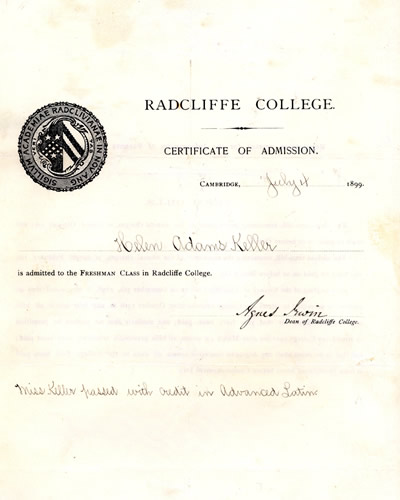
Because Helen Keller was a master of perseverance, willing to take risks, widely admired, smart, accomplished, a pioneer.  In The Story of My Life, we learn that accommodation doesn't mean charity
Perhaps an explanation of the method that was in use when I took my examinations will not be amiss here. The student was required to pass in sixteen hours--twelve hours being called elementary and four advanced. He had to pass five hours at a time to have them counted. The examination papers were given out at nine o'clock at Harvard and brought to Radcliffe by a special messenger. Each candidate was known, not by his name, but by a number. I was No. 233, but, as I had to use a typewriter, my identity could not be concealed. 
It was thought advisable for me to have my examinations in a room by myself, because the noise of the typewriter might disturb the other girls. Mr. Gilman read all the papers to me by means of the manual alphabet. A man was placed on guard at the door to prevent interruption.
.....athlete a wheelchair user?

Because Bob Hall, who was the first wheelchair entrant in the Boston Marathon in 1975 (2 hours 58 minutes) stood up for himself and won.  And nowadays most wheelchair marathoners wait an hour at the finish line for the first sneakered finishers.
The rejection of entrants in wheelchairs for the New York City Marathon has stirred a controversy among officials and competitors affiliated with the Oct. 23 race. 
A record 5,000 runners have been approved for the five‐borough marathon, including applications from competitors who are blind and wear artificial limbs. But the New York Road Runners Club rejected the entry of Bob Hall of Belmont, Mass., and others in Wheelchairs on the ground that their participation constituted a safety hazard during the race. 
“We do not want to jeopardize your safety and that of other participants,” Fred Lebow, the president of the ,New York Road Runners Club, wrote in a Sept. 12 letter to Mr. Hall. In the letter he cited a hazardous route—“five bridges with very narrow ramps”—as the main reason for the rejection. 
Mr. Hall, who competed in the Boston Marathon last spring, has refused to accept the rejection and has called on the New York Civil Liberties Union to assist his case.
“The safety question is really very frivolous,” the 25‐year‐old Mr. Hall said when reached at his home, where he was preparing to leave for another marathon race last weekend in Virginia. “I've been competing with runners for years and demonstrated my ability.”

Chris Hansen, a lawyer for the New York Civil Liberties Union, said he viewed the dispute “the same way as I view race and sex discrimination.” 
“Think how you would feel about running 26 miles or wheeling 26 miles,” Mr. Hansen said. “This is not an electric wheelchair. You have to push yourself every inch. It's an incredible tribute to Bob Hall that he can achieve what he has as a competitor.
“We are actively trying to resolve it out of court. When those avenues are exhausted, then we may have to go to court.”

Federal regulations were approved earlier this year prohibiting any discrimination against the handicapped. Efforts to upgrade programs for handicapped athletes were included in the recommendations of the President's Commission on Olympic Sports.
“The differences in the problems of the handicapped versus those of the able‐bodied,” the commission noted in its recommendations, “are differences only in degree and dissimilar only in the particulars of the individual situation. Essentially all are alike. Only the perceptions provide a contrast.”
....composer deaf? 

Because the Pastoral Symphony never disappoints.
Imagine directing an orchestra you can’t hear. Or playing a soundless piano for a staring audience. 
Beyond composing without hearing a note, Beethoven grappled with living in the 1800s when few understood deafness, hindering his ability to communicate, work as a musician and even find a place to live. How he dealt with this deafness is one of the great stories of humanity, not just of music.

Beethoven began losing his hearing in his mid-20s, after already building a reputation as a musician and composer. The cause of his deafness remains a mystery, though modern analysis of his DNA revealed health issues including large amounts of lead in his system. At the time, people ate off of lead plates — they just didn’t know back then.

Beethoven even continued performing publicly as a musician, which was necessary for many composers of the age: That’s how they got their pieces out, not just composing but performing. For the longest time he didn’t want to reveal his deafness because he believed, justifiably, that it would ruin his career. 
His condition didn’t go unnoticed, however. Composer Louis Sporh reacted to watching Beethoven rehearse on piano in 1814: “…the music was unintelligible unless one could look into the pianoforte part. I was deeply saddened at so hard a fate.”

Once his hearing was fully gone by age 45, Beethoven lost his public life with it. Giving up performing and public appearances, he allowed only select friends to visit him, communicating through written conversations in notebooks. His deafness forced him to become a very private, insular person over the course of time.

A common question is how Beethoven continued composing without his hearing, but this likely wasn’t too difficult. Music is a language, with rules. Knowing the rules of how music is made, he could sit at his desk and compose a piece of music without hearing it.
Beethoven’s style changed, however, as he retreated from public life. His once-vivacious piano sonatas began to take on a darker tone. 
His famous Sixth Symphony also reflects his different life in deafness. Also known as the Pastoral Symphony, the musical work conveys the peace of the countryside, where Beethoven escaped city life after losing his hearing. In terms of his deafness, this was a very important symphony, reflecting the importance as an individual to keep his sanity by being in the country. 
“How delighted I shall be to ramble for a while through bushes, woods, under trees, through grass, and around rocks” — Beethoven in a letter written in May of 1810
This and other pieces from his soundless years reflect his incredible grasp of composition. Beethoven was a master of the language of music, which is about the creation of sound, not about listening.
By California Symphony Music Director Donato Cabrera.
....impressionist nearly blind?


Because Claude Monet painted in his distinctive later style while diagnosed with severe cataracts.
Monet, a founder of French Impressionist painting, suffered from cataracts for much of his later life, during which time he produced some of his most characteristic work. 
Both Monet and Edgar Degas had failing vision, but perhaps we don't appreciate what it meant to these artists. "It gives both new respect for what they could do with limited vision, but also gives us reason to re-examine perhaps what these paintings mean in the evolution of their style and work." Chris Riopelle, curator of 19th century paintings at the National Gallery, said: "I think there has always been a great mystery behind Monet and how much influence his eyesight had on his work."
And the list goes on.  Scientist, statesman, Tenor, Actor, Mathematician.  For each of these people, the phrase "in spite of" isn't operative.  "Because of" is closer, but it doesn't capture the full meaning.  That disability is often a gift.  It can make people better, not worse, different, not defective.  The best of humanity. 

March 25, 2017

Awareness

I had two emails recently, announcing initiatives of OneNS and EngageNS, one inviting me to a webinar on March 27 and the other about a "dashboard" to measure progress. I have trouble remembering which group is which, but I believe OneNS is the descendent of the Ivany Commission and EngageNS is an NGO that has Ramona Lumpkin and Danny Graham on board.

I wrote about the organizations last spring. Of the 32 board members, zero were people with impairments (my new favorite word, as the UN Convention of the Rights of Persons with Disabilities so accurately describes us.)  8 were women.

The Ivany Report, as you may recall, mentions people with disabilities only in the context of 'at risk' groups.  The dashboard of OneNS doesn't seem to have any reference to people with impairments. There could be something on the inactive tab on employment rates.

The upcoming webinar, about the 'Art of Hosting', is coming live from Mahone Bay and is meant introduce "a type of engagement that allows all kinds of people to “step up” and create the change they want to see"

I wrote to EngageNS and heard back right away from Jeff Overmars, who has a new job at Engage NS:

Warren Reed
11:14 AM (1 hour ago)

Dear Ms Randall,

Can you tell me if there will be services for people with disabilities at Monday's Webinar? Things like ASL interpreters, closed captioning or CART services? If there is a live location, is it wheelchair accessible?

Many thanks,

Gus Reed


Jeff Overmars 11:26 AM (40 minutes ago)

Hi Gus,

We met at the 2015 Human Rights Awards. I’m at Engage now and this is our first foray into the webinar format.

Monday’s webinar will only be broadcast online. There’s no in-person attendance.

The recorded webinar will be posted online via YouTube within 24-48 hours and will be captioned. This recording will live on our website permanently and be shared widely via social media.

There had been no requests for adaptive tech/ASL prior to today.

Between now and our Aprill webinar I will look into the integration of CART into a live-stremaining webinar using the Zoom. platform.

If you’d like to discuss this further, I’d welcome a phone call at anytime. You can reach me at 902-719-8534.
I hope all’s well. Are you still south of the boarder?

Kindly,
Jeff

Warren Reed
12:06 PM (8 minutes ago) to Jeff

Thanks Jeff,

It does seem odd that a organization that is largely government funded (76%, 2015 CRA return) embarks on a program "that allows all kinds of people to “step up” and create the change they want to see" would not include deaf folks as "all kinds of people". 24-48 hours delay takes the thrill out of immediate participation. I've been helping arrange ASL for people and it's cheap. No need to wait for a request - it should be the policy of ENS that all events are completely accessible.

Remember Field of Dreams "If you build it, they will come". And even if they don't, you won't have to explain this kind of oversight to taxpayers.

Let me know if the policy changes.

Gus

Finally, I just heard from Jeff:

Hi Gus,

We’ll have ASL for Monday for sure.
Working on CART.
All webinars will have a registration component asking if CART or ASL is required and we will be vigilant to ensure we don’t exclude anyone from participating live. All recorded webinars will be posted to YouTube and captions edited for anyone wishing to view the material following the live events.

Thanks again for your inquiry. If you are available at sometime in the coming weeks in person or remotely via phone or a video chat, I’d like to talk to you about opportunities for further engagement.

Have a nice weekend.

Kindly,
Jeff

All credit to Jeff, who acted with uncommon speed.  It took a couple of hours.

When people with disabilities participate in a group discussion, the subject often turns to 'awareness'.  The UN Convention on the Rights of Persons with Disabilities makes a big deal of awareness in Article 8.  The Access for Ontarians with Disabilities Act promotes awareness.  3 of 4 'Objects' of our own Disabled Persons Commission have to do with 'awareness'.  'Awareness' is a general provision of Bill 59,  the draft Accessibility act in Nova Scotia.

Based on the example of EngageNS, 'awareness' is a synonym for 'huh?'.  Rather than promoting awareness let's promote 'return the money'.  The idea that our government doesn't require beneficiaries of taxpayer largesse to adhere to some diversity standard is just plain irresponsible.

Gerry Post would call this 'low-hanging fruit'.  Government grant recipients have to agree to some rules of equitable treatment.

Gus Reed

ps
What got me started on awareness is this picture of US lawmakers sitting around this week discussing the future of women's healthcare:
Notice anything?

November 5, 2015

The Parallax View


par·al·lax

n.
A change in the apparent position of an object relative to more distant objects, caused by a change in the observer's line of sight towards the object.

I've been very critical of The Federal Government's foot dragging on a range of issues facing people with disabilities.  So I was nearly blown away by yesterday's list of cabinet appointments.  The idea that there is now a Ministry of Sport and Persons with Disabilities is a very good sign and should be the new beginning we have sought for so long.

The long list of cabinet members shows a willingness to rethink government that well might restore Canada's reputation for fairness and equality.  We will all be watching carefully (and critically), but change is in the air and we're hopeful.

The name 'Sport and Persons with Disabilities' reflects a basic tension.  I like the association and feel strongly that sport has provided one of the few opportunities for excellence.  But therein lies the heart of the issue - are limitations inherent or caused by arbitrary barriers?  Should government be thinking about my disability or the barriers that cause it?  So 'Sport and Access' or 'Sport and Equality' would have been more to my liking, but a distinction without a difference for most people.

In any case, the full realization of equality will take the participation of many ministries - Labour, Justice, Transport, Health, and others.

Carla Qualtrough, the new minister, surely gets it.  I'm not a big fan of BC's accessibility efforts - accessibility is a matter of right, not subject to negotiation - and their timeline is ridiculously long. But Qualtrough has the right credentials and if Trudeau follows through on his promises, the stage is set.

Trudeau's answer to the question "Why gender balance in cabinet?", "Because it's 2015" says it all in seven syllables.

Canada has compared badly with the US in the area of disability rights, but now that we've got:

  • A Sikh Minister of Defense
  • A  First Canadian Justice Minister 
  • A  gay President of Treasury Board
  • A Sikh Minister of Economic development
  • An astronaut(!) Transport Minister
  • A wheelchair-using Minister of Veteran's Affairs
  • An Afghan-born Minister of Democratic Institutions
  • A scientist Minister of Science
  • A Paralympian Minister of Sport and Disability
  • A thing called the Ministry of Environment and Climate Change
  • And other breathtaking choices

we've shown the world what Canada is and wants to be.  Expectations are high.

March 7, 2014

Catch-22

"You mean there's a catch?"

"Sure there's a catch", Doc Daneeka replied. "Catch-22. Anyone who wants to get out of combat duty isn't really crazy."

There was only one catch and that was Catch-22, which specified that a concern for one's own safety in the face of dangers that were real and immediate was the process of a rational mind. Orr was crazy and could be grounded. All he had to do was ask; and as soon as he did, he would no longer be crazy and would have to fly more missions. Orr would be crazy to fly more missions and sane if he didn't, but if he was sane, he had to fly them. If he flew them, he was crazy and didn't have to; but if he didn't want to, he was sane and had to. Yossarian was moved very deeply by the absolute simplicity of this clause of Catch-22 and let out a respectful whistle.

Catch-22
Joseph Heller

I hope you have read Janice Hudson`s excellent article in Halifax Magazine. It's a fair presentation of the accessibility, or more precisely the lack thereof, in Halifax. There are two quotes in the article that deserve special attention:

  • Retrofitting Halifax’s older buildings can be complicated. “If you have a historic building with a series of steps, you could always build a ramp but not if it abuts the sidewalk,” Paul MacKinnon, executive director of the Downtown Business Commission says. “Seven feet of sidewalk clearance is required so two wheelchairs can pass each other.”
Think about it.  You can't get into Jennifer's on Spring Garden to buy a Mother's Day gift because they don't have a ramp.  They don't have a ramp because of a rule requiring enough room for wheelchairs to pass on the sidewalk.  So Jennifer's doesn't have wheelchair access because of a rule to protect people in wheelchairs.  Perfect!

  • Buildings that have always been inaccessible usually stay that way. “It’s accepted that there are particular challenges for buildings in urban settings, so there are special provisions that provide alternative compliance methods,” says Jim Donovan, HRM’s manager of municipal compliance, the department that issues building permits.

By "alternative compliance methods", Donovan doesn't mean "There's another way to get into the building".  He means "They can comply with the building code by not complying with the building code."  Although this is classic Catch-22, it also falls into "It can't be done" and it's many variations:

  • “I don’t know how to do it.”
  • "I don't want to do it."
  • “it can’t be done the way we've always tried in the past.” 
  • “it can’t be done according to the only way I can think of doing it.”
Mayor Savage's Healthy Communities Priority Outcomes initiative implausibly says: 
  • “HRM is a leader in building an inclusive and accessible community for everyone, including persons with disabilities and seniors”
There must be a catch......................

Gus Reed


January 11, 2014

Snowden v. Shannon

Edward Snowden did the world a service by exposing the uncontrolled spying activities of the US National Security Agency. Dave Shannon did no less for the people of Nova Scotia (Human rights vs. red tape in N.S. - Chronicle Herald January 7) by exposing the Byzantine bureaucracy, paralysis and consequent ineffectiveness of the Nova Scotia Human Rights Commission. He makes serious allegations that go to the heart of what makes government legitimate.

Shannon doesn't provide the detailed evidence that Snowden does, and the Chronicle Herald needs to dig deeper with credible investigative reporting.  They must finish what they started.  But the barn door is open.

Shannon`s condemnation of the NSHRC`s "bureaucratic paper-pushing, “internal petty bickering” and personnel problems" exactly mirrors my experience. I filed a complaint in 2006, thinking it could remedy much of the discrimination visited upon disabled Nova Scotians.  I was helped by a professor at Dal Law School, who seemed to think we made a pretty good argument.  We expected at least a consideration of the issues.  Instead we found a secretive organization obsessed with using the proper paper form (Complaint forms prepared by someone other than Commission staff will not be accepted ), sloppy in its "investigation" (no opportunity for me to speak to the Commission`s sources), and relieved to find jurisdictional grounds to dismiss the complaint. In short a culture without any interest and understanding of Human Rights.  Says the Chronicle Herald:
Shannon found he couldn’t steer the ship toward advancing “the dignity and self-worth of the individual” under the terms of Nova Scotia’s Human Rights Act. “Not everyone in the office shared that perspective.”
He doesn't stop there:
“There were also the impediments of having to work around key people who attempted to undermine the vision of the commission, and that was highly frustrating,” Shannon said.
“Essentially, they were individuals trapped in a linear and bureaucratic paralysis that advanced paperwork rather than human rights,”
I'm wondering what other perspective might be at work in a Human Rights organization, especially since the Universal Declaration of Human Rights begins:
Whereas recognition of the inherent dignity and of the equal and inalienable rights of all members of the human family is the foundation of freedom, justice and peace in the world..........
But this isn't about me, it's about Nova Scotia.  When you are subject to discrimination because you're poor, a minority, fired, bullied, disabled, a woman, gay, ill, a Mormon, over 65, under 12,  a Jew, does Shannon's description of the performance of the Human Rights Commission give you confidence that your interest will be served?  Shannon calls into question the vision and commitment of this commission and the administration of justice in the Province.

There are 12 commissioners, including the present director.  The NSHRC website says commissioners "are responsible for the strategic direction of the Commission as well as for making decisions on human rights issues" By Shannon's account, they have failed at both. For their own credibility, they should explain themselves, embrace transparency, and invite an independent review. They owe us that. Every decision of the NSHRC is under a cloud.

The main asset of acting director Tracey Williams is  "more than 31 years of experience at all levels of government, half of which have been in senior executive roles".  She's an experienced bureaucrat, and that might be exactly the problem.  Surely there are more pertinent job qualifications.  Is she an attorney?  Is she experienced in the field of Human Rights?

Shannon's indictment of the NSHRC should raise alarm bells.  Is it sour grapes?  I doubt it, but the air needs to be cleared before the NSHRC can have a shred of credibility.  The government needs to work very hard to overcome the now widely held perception of the NSHRC as bureaucratic, ineffective and rudderless.  Fortunately, the new premier and his government bear little responsibility for the Commission's shortcomings, and should seize this opportunity to restore confidence in a vital agency. 

The Chronicle-Herald adds: "The government says things have improved at the commission."  Now there's a halfhearted endorsement!  We need evidence.

Gus Reed


February 8, 2013

Off The Radar


Using Google Trends one can get a sense of where Nova Scotia fits in awareness of Disability Rights.  Worldwide, New Zealand is the place where it's a hot topic - Kiwis get 100.  The 100 considers the total search traffic for each area and is assigned to the location with the highest likelihood that any search will be for 'disability rights'.  Hovering your mouse over Great Britain shows 67, meaning that any search in GB is two-thirds as likely to be for 'disability rights' as in New Zealand.  It's a measure of relative popularity.   46 in the US, 23 in Canada.

Limiting the area of interest to Canada, we find Ontario with 100, BC with 61 and the rest zero.  So in Canada, the highest likelihood of searching for 'disability rights' is in Ontario, and in BC it's 61% as likely compared to Ontario.

If you look in Nova Scotia alone you get this message:
Not enough search volume to show graphs.
To get a sense of how the topic of disability rights compares with a similar topic in Canada, we can add another term.  'charter rights' is 23 times more likely to be searched than 'disability rights'.  This time, Alberta gets 100 (surprise!) but Nova Scotia has a respectable 59.

Looking for something that truly matters, check out 'hockey' (worldwide, Canada = 100), which has a strong showing in every Province and Territory - Nunavut dominates with 100, Nova Scotia is 67.  By comparison, 'disability rights' creates nary a ripple.
Nothing really surprising here, except confirmation that it's up to us to make ourselves heard.  It's interesting that in a province with a Disabled Persons Commission in a country that signed and ratified the UN Convention on the Rights of Persons with Disabilities there is little interest in the subject.  Disability Rights are not a Google Trend in Canada.

The takeaway here is that language matters.  Everyone has Charter Rights but only people with disabilities have disability rights.  To the degree that the UN Convention allows 'disability rights' to be considered separately, it permits a distinction that is ultimately harmful to the cause.

October 26, 2012

Incarceration of Information


Are you dying to find the latest annual report of the Nova Scotia Disabled Person's Commission (DPC)?  Look no further than the Disabled Persons Commission Annual Report 2002-2003.  Although Canada signed the UN Convention on Persons with Disabilities on March 11, 2010, it's still 3 years in the future for the DPC.

These 5 to 9 year old reports are among the most current documents on the website of the Nova Scotia Disabled Persons Commission, which today (October 26, 2012) proudly announces


I received a response on July 12, which is reproduced in full here, and contains details of:
  • efforts to increase the commission’s staff, to create a Disability Strategy for the province and to redesign the website to be fully accessible.
  • A new and fully accessible website currently in the testing stage with the expectation that it will be rolled out by early Fall. 
  • Links to 3 additional statistical reports, published in 2009 and 2010, all reviewing 2006 data 
  • A list of current Commissioners
  • Caution that many of the issues are complex and progress can be incremental. 
  • And concluding with pride
    • "I’m proud of our work and look forward to an expanding role for the commission as we embark on developing the Disability Framework." 
Nice, but not exactly the flood of pent-up information I was looking for.

So with my friend and fellow blogger Parker Donham, I filed a Freedom of Information Request on July 16, asking for the minutes of the Minister's Steering Committee meetings (twice a year for ten years) and the draft Disability Strategy and Disability Framework (whatever that is).


Not having heard by August 16, I inquired and learned there was no record of my request.  Should I have spent $10 to send registered mail?  


  • So the 30 days for the DPC to respond actually started running August 16.
  • September 16, a 30 day extension is sought 
  • October 18, another 30 day extension, granted by the Freedom of Information Review Officer without consulting us.

90 days is way too long.  I think these people
  • don't do anything
  • have never written another annual report
  • have confused 'disabled' with 'stupid'
  • have confused 'disabled' with 'passive'
  • need to be held accountable
As a disabled person, I'd like to be wrong about the people who are supposed to protect my interests.  So maybe I could get an answer before the UN Convention is signed.  3 years ago!

Gus Reed

PS Here are a half dozen studies that should have been done:

  • Making Departmental Websites and Services Accessible
  • The Payoff for Accessible Tourism
  • Physical and Programmatic Barriers to Employment
  • Accessible Transportation in Rural Nova Scotia
  • Recreational Opportunities for Nova Scotians with Disabilities
  • Moving Beyond a Medical Model of Disability

September 9, 2012

Change your city!


On the left is  a link to a petition asking HRM Mayoral candidates to show us their plan to comply with the  UN Convention on the Rights of Persons With Disabilities.  This treaty, which the Human Rights Commission says binds HRM and all levels of government, requires a systematic effort to identify and remove barriers.  We ask candidates to outline their plan in 5 steps

  1. make accessibility a central goal of their administration
  2. identify and eliminate obstacles and barriers to accessibility
  3. review procedures and policies and develop plans to ensure equitable access
  4. encourage persons with disabilities to take an active role in government
  5. include accessibility as part of the mission and responsibility of every department

Accessibility is a big issue in HRM, and voters are entitled to know how candidates would improve it.   An accessible city helps such disparate goals as employment, business creation and tourism.  Here are some approaches to each of the 5 items, but we want to hear the candidates ideas.

1.  Articulate a broad and comprehensive statement of why accessibility is important and what measures HRM will take to achieve it.
2.  Publish a map, publish a list, request emails and phone calls, invite the public to participate, ask the CNIB, the CPA, the  Society of Deaf and Hard of Hearing Nova Scotians to participate.  Require municipal departments to report barriers to access.
3.  Ask the HRM Auditor to be sure every program and service meets standards of fairness.
4.  Review the powers, responsibilities, composition and structure of HRM's Accessibility Advisory Committee.  Who do they report to, what is their mandate, what support do they get?  What is their record and how could it be improved?  Develop a staff position to oversee the implementation of full accessibility.
5.  Require a section in each department's annual report detailing which of their responsibilities affects accessibility and what measures are being taken.  Appoint an Accessibility Officer in every department to conduct public discourse.

So please sign the petition and we'll see what develops.

Gus Reed

PS and pass it along! 

August 30, 2012

Daring to be different | The Chronicle Herald

Canadian wheelchair athlete Josh Cassidy, who recently set a world record at the Boston Marathon in the wheelchair division, trains in Toronto on April 25, 2012. Cassidy will be representing Canada at the 2012 Paralympics in London, England. (NATHAN DENETTE / CP)

This op-ed appeared in the Chronicle Herald August 30, 2012

All 20 of the fastest times in the 2012 Boston Marathon belong to wheelchair racers. In fact, Canadian wheeler Joshua Cassidy (1:18:25) had time for a nap while waiting for Kenyan runner Wesley Korir (2:12:40) to finish. A luxurious 54 minutes, to be exact. Gravity? The course does drop 425 feet in 26 miles — a barely noticeable three-tenths of one per cent grade — but that benefits runners and wheelers alike. Meanwhile, the course has some daunting uphill stretches, and dragging an extra 15 pounds of wheelchair up Heartbreak Hill surely offsets any advantage from turning potential energy kinetic.


But this is apples and oranges, angels and pins. One shouldn’t be confused by the artificiality of divisions into thinking there is a single winner of the Boston Marathon, and then some women and then some wheelchairs. They’re all committed athletes, running the same race differently.

People with disabilities have a special perspective on difference — we are, in many ways, defined by it. Many of us embrace our differences as extraordinary gifts.

Some would say Stephen Hawking won a Nobel Prize in spite of his condition. People with more imagination might wonder if it’s because of his condition. Conventional thinkers see him as suffering from Lou Gehrig’s disease. (Lou, by the way, was not a bad ball player.) I’d say Stephen Hawking is a pretty spectacular physicist and that there’s a decent chance his achievement is connected to his physical characteristics. At the very least, his circumstance provides an unusual perspective on the universe. His work habits, his personality and maybe even the way his brain is wired are hard to separate from his success.

Without variety, we are doomed as a species. Some think people with disabilities are defective. They forget that nature’s experiments made it possible for chimps to walk upright and for plants to have sex. In fact, people with disabilities live at the leading edge of biological, cultural and technological evolution. As exemplars of diversity — living experiments — people with disabilities represent possibility, not failure.

When the rest of us can’t cope with the heat of global warming, someone with an unusual genetic makeup may be as cool as a cucumber. When the next avian flu arrives, a difference in blood chemistry may confer immunity. Genetic differences are humanity’s insurance policy — not a sideshow, but the main evolutionary event. People whose disability arises from non-biological causes (like accidents and injury) are often the first to use new technologies and inspire us to think of useful applications. And people with disabilities challenge our cultural assumptions every day.

We are a creative bunch, navigating the obstacles carelessly strewn across our physical and psychic environment. Imagine living in a world designed for aliens. Steps, books, iTunes, fibulas and sinks work for most of you. That’s great. But it’s more than a little entertaining figuring out how to make stuff work for the few of us. Artists paint with their feet, Aaron Fotheringham does flips in his wheelchair, Oscar Pistorius gets to the Olympics, Helen Keller got to Radcliffe and beyond. Life is a problem set and people with disabilities get an abundance of bonus questions.

Problem solving fortified with perseverance can unlock many puzzles. What would Sisyphus be without his rock? A disability is a lifelong exercise in persistence and patience and a lesson in how to plan for every eventuality. When one approach doesn't work, try another, and another. As Camus observed in his essay on Sisyphus, “The struggle itself towards the heights is enough to fill a man's heart.”

Do watch the Paralympics, remembering that the athletes are pioneers of the next chapter in the human story, and then follow along as best you are able.

Warren Reed is a human-rights advocate who lives in Halifax.

July 12, 2011

How charities work against the disabled

In the wake of recent revelations about Canadian charities, here is a reminder that the exploitation of disabled people for the purpose of lucrative fundraising is not new.  Ben Mattlin, who is the moderator of a disabilities SIG I belong to, wrote this terrific letter about the Jerry Lewis Telethon.  2010 was the final appearance of Jerry.  This letter is 20 years old.  So little has changed, yet there are glimmers of hope.

The letter appeared in the Los Angeles Times on September 1, 1991, on page 3

PERSONAL PERSPECTIVE An Open Letter to Jerry Lewis: The Disabled Need Dignity, Not Pity
by Ben Mattlin

Dear Jerry Lewis:

I was born with a muscular-dystrophy-related disease, and your Labor Day telethons have always turned my stomach. I actually appeared on one in the late 1960s, as the Muscular Dystrophy Assn. poster child for the New York metropolitan area.

Now I am 28, a Harvard graduate, a self-employed writer, married, still in a wheelchair. I can finally formulate what I felt as a child: Despite your undoubtedly honorable intentions, you are sadly misinformed about disabilities. Moreover, you are misleading the able-bodied population while offending the rest of us.

You and your organization have done much good, to be sure, and I myself have benefited from your financial resources. But people with disabilities do not need or want to be characterized as objects of pity. Last year's Americans With Disabilities Act mandates our equal participation in society, including employment. What we need is to stress competence-not outmoded notions of charity.

Speaking of "the dystrophic child's plight," or calling disability a "curse" reinforces the offensive stereotype that we are victims. Wheelchairs are not "steel imprisonment," nor are we who use them "confined" or "bound"; they are liberating aluminum and vinyl vehicles. Similarly, phrases like "dealt a bad hand" and "got in the wrong line" are unfair. Disability is not "bad" or "wrong."

Other examples abound: Being dressed or fed by others is a hassle, but not an "indignity." There is no shame in needing others, no loss of dignity. Our needs are more personal and continuing than other people's-nothing to be ashamed of.

Saying that they are is to say our lives are somehow inferior. Is this how you feel? You have said our lives are "half"-we must learn to "do things halfway," be good at being "half a person." Even slaves in the Old South counted for three-fifths of a person.

Perhaps more disturbing is your use of the archaic word "cripple." While some of us have recently taken it on as a kind of hip slang among ourselves or for political purposes-much like the gay-rights group Queer Nation-this does not mean you should.

Worse still may be your ubiquitous "Jerry's Kids"-never more absurd than when followed by "of all ages." Yes, a lot of MDA's clients (not necessarily "patients") are kids, but do you know how hard it is to become, and be treated as, a self-respecting disabled adult in this society? You may argue it is a term of affection, but you wouldn't refer to your late friend Sammy Davis Jr. as your "boy."

What's really surprising are your inaccuracies. Your tales of disabled kids being taunted by other kids, for example, do not ring true. Most able-bodied kids whom I knew growing up couldn't wait to push my chair. They would even compete to be "chief wheeler."

You further allege that wheelchairs don't fit under restaurant tables, when for years they have come with "desk armrests." And what's this about their not going through metal detectors at airports? Big deal-they're metal! They go around them and are searched separately.

At times, you seem to understand. You talk about our right to live with dignity. What that means is access to schools and jobs, equipment like computers and vans, attendants and respect. The MDA can't be responsible for all this. But misleading people-potential employers, potential spouses, and even newly disabled people who don't know any better-only works against these goals.

When I was about 6 years old, I was in a full-page magazine ad for the MDA: big blue eyes peeking through blond curls. The caption read, "If I grow up, I want to be a fireman." I didn't want to be a fireman, and knew then my diagnosis called for a normal life expectancy. Confused, I decided that I wasn't really one of "them" and denied a part of my identity, my connection to the only community where I could learn to feel good about my disability. I didn't know the word "exploitation" yet.

I realize pity works-last year's telethon raised more money than ever before. And I know some folks think you're a saint. But I also know there were protests at last year's telethon-and will be more-asking why it has taken so long to find a cure and demanding a financial accounting.

Perhaps people would not be so upset if the association spoke less about finding a cure and did more to improve our lives as they are. I know MDA does buy wheelchairs and such. But what does it do to make our world more accessible and to promote employment? How many people with disabilities are employed by the organization and its corporate sponsors?

Don't get me wrong. Muscular dystrophy can be a killer, and we mourn our brothers and sisters who have died. Yet, despite the impression that one may get watching the telethon, we are not all terminal. And even if you whip MD, you will not end disability. It is here to stay; so are we.

Why not, this year, present active, well-adjusted disabled people-not superheroes but normal people-who nonetheless have used or could use financial assistance to achieve their goals of independent living?

The harm being done is considerable. A dynamic, young, educated, professional woman I know, who grew up with a disability similar to mine, says she cannot watch your telethon because it makes her want to kill herself. "Is that what people think of us?" she asks.

Your pity campaign is so dispiriting, so destructive, that no matter how many millions you raise, the ends do not justify the means. Why not wield your sizable influence to fight our real enemies? What truly handicaps us most are the obstacles-architectural, financial and attitudinal-erected by others.

(Copyright, The Times Mirror Company; Los Angeles Times 1991All Rights reserved)

December 15, 2010

New Central Library

Page 6 of the architect's final presentation of November 4 promises a fully accessible building.

So pardon our skepticism when we looked carefully at all 74 pages of the presentation and did not find a single wheelchair, stroller or person with a cane.  In fact, amid all those healthy Haligonians, there is virtually no visible minority.

Pshaw! you say.  This is merely an oversight, an artifact of the available selection of images for dreamy architectural renderings.

Well, architects who make oversights commit errors we have to live with for years.  And pay for!

On page 38 we are treated to a panoramic view of the first floor interior.  The information desk at lower left (information being what a library is meant to dispense) is in the form of a high counter, way taller than a person in a wheelchair, or a child for that matter.  There are loads of specifications for including low sections in counters, but the very idea of a counter runs, well, counter to the precepts of barrier-free design:
The Center for Universal Design at North Carolina State University identifies the following principles:
  1. Equitable use
  2. Flexibility in use
  3. Simple and intuitive
  4. Perceptible information
  5. Tolerance for error
  6. Low physical effort
  7. Size and space for approach and use
So a tall counter for regular people and a short counter for kids and wheelchairs offends principle 1, 2 & 7

On page 40 we have an image of what is surely the main index to the collections.  What used to be a card catalogue is now a bunch of computers.  The architect has outdone himself by putting the computers way out of reach atop those self-conscious bar tables you find in trendy restaurants.  Likely, wheelchair users and other non-gymnasts will be off in a corner at an ordinary temporary desk. 


Principles 1,2 & 7 again.

On page 39 we seem to be looking into the cafe, which presents a long counter too high for a wheelchair user.  Doubtless the cashier will be elevated at some distance above a customer, and wheelchair users will have to fumble with the credit card machine and won't be allowed to see the register screen.

1,2 & 7........

Finally. on page 42, is what we hope architects learn in architect school.  A seamless blending of a ramp for accessibility and stairs for seating.  Wheelchairs can get to the lower level and virtually any seating level.  Bravo!


For this one act of inclusion, all is not forgiven.  Don't you believe the "oversight" excuse.  Disabled folk are invisible in Halifax, just as they're omitted in these 74 pages.  Clearly, this architect doesn't know from accessible.

Gus Reed


November 6, 2010

A matter of respect

Dear Wheelchair Users,


At the Department of Social Services website you will find that the government of Nova Scotia thinks your wheelchair limits you.  You will find that attitude reflected in countless ways, including an October 25 article in the Chronicle Herald, about Bob Sheeny's transportation difficulties while attempting to visit his hospitalized friend.  The reporter managed to add insult to injury by using these two sentences:

The driver even called his supervisor, who confirmed that wheelchair-bound passengers are not allowed on the 60.
However, Sunday morning the driver said that he could get in a lot of trouble for letting wheelchair-bound passengers onto non-wheelchair routes.

On the previous Friday, Gordon Delaney of the Chronicle's Valley Bureau wrote:

Amy Paradis, 16, is quadriplegic and confined to a wheelchair

Evidently, the style manual in use at the Chronicle Herald requires the modification of wheelchair either with confined or bound.   This must be in the chapter on Gratuitous 19th Century Misconceptions.  At DSS, they can't say wheelchair without saying limited.  Bob Sheeny's wheelchair doesn't seem to restrain him in any way.  In fact, what prevents him from visiting his friend is not his disability, but the intransigence of Metro Transit.  Without the discriminatory foot-dragging of Metro Transit, Mr. Sheeny would be able to get on any bus in HRM - just like he could in London or New York.

It's not that Mr. Sheeny can't do things, he's prevented from doing them. 

It is discouraging, 10 years into the 21st century, to find a government department so mired in the distant past that the word wheelchair must be modified by 'limited'.  Tempting as it is, I try not to reflexively use 'dinosaur' as the modifier of 'government minister'.  You'd think a government department charged with serving people would take the trouble to understand their circumstances.

Not in Nova Scotia, where the 19th century has a firm grip.  Public servants and journalists should train themselves to use the much more accurate phrase wheelchair user.  Wheelchairs are enabling and liberating.


Gus Reed


August 14, 2009

The End of the Beginning?

The world is round and the place which may seem like the end, may also be the beginning.
- Ivy Baker Priest


Many people breathed a sigh of relief when HRM Council voted Tuesday to continue free Metro Transit passes for blind Haligonians. I attended the meeting, and it was remarkable how eager Councilors were to put this issue behind them. Councilor Blumenthal made a brief and emotional comparison of heroic blind bus passengers and Sidney Crosby before moving to ignore the staff recommendation to terminate the passes. The rush to second the motion, the lack of discussion and the near-unanimous vote in favor made it clear that Council was anxious to put this episode in the rear view mirror. It was gratifying nonetheless.

I was pleasantly surprised to see that the first floor washrooms in City Hall are being renovated to make them accessible. This has been on my list for years - citizens ought to be able to pee after they pay their taxes.

Wheelchair users will be impressed with the spiffy new ramp at MLA Leonard Preyra's constituency office at the corner of Young Ave. and Inglis St. He is apparently doing more renovation inside so that a disabled person can actually see his or her democratically elected representative. A disabled person could apply for a job in Leonard's office. Good for Leonard.

These are good signs, but the problem is that they are isolated, voluntary events. There is no overarching policy or even a promise to include people with disabilities in everyday life. We have repeatedly had the lesson that HRM staff is not required to consider accessibility as it plans and executes the business of the city. MLAs can maintain offices upstairs or behind narrow doors, and do it at your expense.

Problems faced by people with disabilities, such as unemployment and isolation are not the inevitable consequences of the limitations imposed by the disability itself. That crazy argument about recalling the bus passes because of "informal complaints" from other groups with disabilities is like "Obama Death Panels" - untrue, cynical and specious. People with disabilities know that it is the system that is stacked against them, and do not begrudge the few benefits received by other people with disabilities.

Just before the council meeting was called to order, I overheard a Councilor lamenting the presence of dogs accompanying blind audience members. She said "What are all these dogs doing here? I hope I don't end up in the hospital", thereby confirming the impression that, for her, being a Council member has nothing to do with you and me, and everything to do with her.

Be vigilant and carry on!

Gus Reed

October 25, 2008

In support of the UN Convention on the Rights of Persons with Disabilities

In August 2007, I wrote a critique of Canada’s signing of the UN Convention on the Rights of Persons with Disabilities. It is short and found at http://jmcgs.blogspot.com/2007/09/opinion.html .

In September 2007, I wrote to Steve Estey and Dave Shannon, Nova Scotians who were involved in negotiating the document, asking for comments, but did not hear back. On September 24, 2008 - a year later - I made reference to the lack of a response from Estey and Shannon in response to an email urging me to write to my MP in support of ratification of the treaty:

Last September, I asked for comments from Steve Estey and Dave Shannon, neither of whom has seen fit to respond in any way.

......I am disappointed that neither Steve nor Dave will discuss the implications of this treaty. They take credit for it and they should explain it.
and received this reply on October 1. I believe it is in the best interest of people with disabilities to be familiar with this Convention and to engage in thoughtful debate.

Gus Reed

********************************************************

Gus

I did not receive your earlier email, so I did not reply. You know you can call me respecting these issues any time, so don`t get pissy about me with third parties. If anyone should be disappointed it is Steve and I for not being given a second chance by you with the courtesy of a message confirmation.

Respecting the CRPD, I would agree with Steve that it is not a panacea. The Canadian Charter is not either. The few words of section 15 highlight its great limitation for persons with a disability because it does not guarantee economic, social or cultural rights. The CRPD says on a global stage to Canada that it is limited in its application of disability rights because the new paradigm fuses both individual and group rights. Also, Chief Justice Dickson (as he then was) stated that Canada must interpret domestic law in a manner consistent with its international legal obligations to the full extent possible. These are powerful points of leverage for future promotion of disability rights using the CRPD.

I believe that a Canadians With Disabilities Act would be a further valuable tool in individual and systemic advocacy. It remains policy for the three major frderal parties, but notwithstanding the fact that several NGOs continue to push for a CDA, it has not yet come to fruition.

As you know, in Nova Scotia persons with a disability are discriminated against on a daily basis, and often face barriers that were removed in other jurisdictions a generation ago. Clearly governmental processes and programmes in place to promote equal participation of Nova Scotians with a disability are failing.

One in eight Canadians has a disability (3.6 million people). For Canada’s Aboriginal population, the rate of disability is more than one and a half times the rate for the non-Aboriginal population. Women are more likely than men to have a disability, regardless of age. Within Canada the potential market of persons with a disability is valued at over 25 billion dollars.

Statistics do not reveal the emotional and financial effect that barriers facing persons with a disability has on this community, and their family members, loved ones, neighbors and co-workers.

Among the daily obstructions experienced by disabled Nova Scotians are: &#

  • Manageable transportation
  • Available housing
  • Accessible educational opportunities
  • Attention to personal needs
  • Admission to leisure and entertainment facilities
  • An unemployment rate greater than 55%

Sadly, while for many years Canada was accounted an international leader in the promotion of rights and opportunities for the disabled. More recently, this position has slipped as disability advocacy groups have been forced to jockey against each other for government funding and support. In Nova Scotia the situation may be the poorest for persons with a disability throughout all other provincial jurisdictions. It is almost impossible to get a wheelchair accessible taxi, city buses often do not have accessible routes, many Nova Scotians with a disability do not have secondary education, and poverty among this group is at a level equal to third world proportions.

Of greater concern for persons with a disability are the condescending attitudes of `pity’ and ‘sympathy’ and the belief that the disabled must be ‘looked after for their own good’. This not only engenders forms of marginalization for the disabled but, moreover, in a cruel reversal, serves to internalize the message of exclusion to the disabled themselves. By minimizing their own expectations for equality and dignity, contemporary society effectively underlines the inequity and discrimination people with disabilities are trying to overcome.

In Ontario and throughout the world, governments have increasingly turned to the development of Disability Acts to address the needs of persons with a disability. On the whole this approach draws on existing bodies within a particular jurisdiction such as human rights acts or disability secretariats. The legislation then provides a holistic and comprehensive human rights approach to creating a fully inclusive community. Essentially, this legislation creates disability rights and policy by doing the following:

  • Involving all stakeholders in discussions to make policy and programme changes
  • Acknowledging that equality begins with understanding that discrimination exists
  • Making dignity for persons with a disability part of organizational values and a standard to measure people against
  • Encouraging a respectful and inclusive province. No one wants to be excluded.

In The Accessibility for Ontarians with a Disability Act (AODA) the government of Ontario was the first Canadian jurisdiction to adopt a Disability Act. They chose to enforce the Act with a series of voluntary measures, bureaucracy, Advisory Council and Tribunals. The Ontario Government has stated that it is committed to a fully accessible Ontario by 2025. The recent appointment of a well known disabled person who actively supports the AODA as Lieutenant Governor may suggest that the Ontario Government is sincere in its efforts.

In March 2007 Canada became a signatory to The United Nations Convention on the Rights of Persons With A Disability. Each Province supported the Federal Government in its decision to sign the Convention. The stated purpose of the Convention is “to promote, protect and ensure the full and equal enjoyment of all human rights and fundamental freedoms by all persons with disabilities, and to promote respect for their inherent dignity”. The Convention is both a development and a human rights instrument. It is also a legally binding policy instrument which is cross-disability and cross-sectoral.

The Convention marks a ‘paradigm shift’ in attitudes and approaches to persons with disabilities. Persons with disabilities are not viewed as "objects" of charity, medical treatment and social protection; rather as "subjects" with rights, who are capable of claiming those rights and making decisions for their lives based on their free and informed consent as well as being active members of society. The Convention gives universal recognition to the dignity of persons with disabilities.

As you have noted, in Nova Scotia the time has come to remove the barriers faced by persons with a disability. A paradigm shift is needed, and a Nova Scotians With Disabilities Act will be central to change for an equal and inclusive province. I believe the CRPD will add significantly to the discourse on disability rights here at home. The dilemma always remains effective enforcement of the rights.

The most significant advantages of the CRPD include:

(i) providing an immediate statement of legal accountability regarding disability rights;

(ii) clarifying the content of human rights principles and their application to people with disabilities;

(iii) providing an authoritative and global reference point for domestic law and policy initiatives;

(iv) providing mechanisms for more effective monitoring, including reporting on enforcement, supervision by a body of experts mandated by the CRPD, and the consideration of individual or group complaints under the Optional Protocol;

(v) establishing a useful framework for multi-sectoral cooperation;

(vi) providing a fair and common standard of assessment and achievement across regions; and

(vii) creating a broad forward looking rights based consensus providing transformative educative benefits.

Inequality for persons with a disability has everything to do with the denial of dignity, and that dignity cannot be reclaimed without several supports in place to promote inclusion. z The general principles of the CRPD also create a powerful framework for the development of future Canadian disability policy. They include the following:

• Respect for inherent dignity, individual autonomy including the freedom to make one’s own choices, and independence of persons

• Non-discrimination

• Full and effective participation and inclusion in society

• Respect for difference and acceptance of persons with disabilities as part of human diversity and humanity

• Equality of opportunity

• Equality between men and women

• Respect for the evolving capacities of children with disabilities and respect for the right of children with disabilities to preserve their identities

• Reasonable accommodation for persons with disability

• Awareness-raising of the great potential of persons with a disability

• Provision of habilitation and rehabilitation

• Collection of statistics and data

• Federal and inter-provincial cooperation

• Provincial implementation and monitoring

• Right to life, liberty and security of the person

• Equal recognition before the law and legal capacity

• Freedom from exploitation, violence and abuse

• Right to respect physical and mental integrity

• Freedom of movement

• Right to live independently in the community

• Freedom of expression and opinion

• Respect for privacy

• Respect for home and the family

• Right to education

• Right to health

• Right to work

• Right to adequate standard of living

• Right to participate in political and public life

• Right to participation in cultural life

• Access must be ensured to:

· Justice

· Living independently and being included in the community

· Information and communication services

· Education

· Health

· Habilitation and rehabilitation

· Work and employment- human resource policies and practices

· Adequate standard of living and social protection

· Participation in political and social life

· Participation in cultural life, recreation, leisure and sport

The CRPD makes it clear that limitations on resources is not an excuse to deny equality unless it causes undue financial hardship. Limited resources have to be prioritized according to reasonable and objective criteria and funding must be proportional. The UN suggests that these strategies for effective use of limited resources be used:

  • Target low-cost programmes
  • Target people in the most marginalized situations
  • Be non-discriminatory
  • Draw on national cooperation
  • Include persons with disabilities in all stage

Success of the CRPD will also require mainstreaming disability in existing processes, programmes and policies. No Ministry, department or entity can achieve the goal of equality for persons with disabilities on its own. An interconnected network of actors is required to reach this goal. Therefore, different entities need to ensure that their respective spheres of responsibility provide the necessary opportunities and access to persons with disabilities on an equal basis with others. If any one element of the network fails in this obligation, persons are not able to reap the benefit from the other elements. Both the AODA and CRPD use this strategy.

The CRPD also has established a Committee of Experts to meet in order to consider any matter with regard to the implementation of the Act. Furthermore, there is a Secretariat tasked with reviewing implementation of the Act. This provides new resources for the promotion of disability rights globally. The UN notes that together the Committee of Experts and Secretariat undertake the following:

  • Advocate the equalization of opportunities for, the full enjoyment of all human rights by, and the well-being of persons with disabilities in all respects;
  • Create awareness of the CRPD
  • Act as a catalyst to promote international, and technical cooperation on disability issues, including by identifying strategic areas for the exchange and sharing of expertise, best practices, knowledge, information and relevant technologies in order to enhance the capacity-building of all relevant bodies
  • Collaborate in the fulfillment of the above tasks with all relevant stakeholders, including organizations of persons with disabilities

In light of the above, even with the CRPD the challenges remain enormous for persons with a disability in Nova and throughout the world. While work should continue in earnest to implement the CRPD, there should be no diminution of the energy exerted for parallel initiatives. This includes test case litigation, data retrieval, policy research, disabled persons organizational capacity building, and awareness raising to name a few. These efforts should not be seen as mutually exclusive, but be part of a synchronized spectrum of activities aimed at guaranteeing dignity for persons with a disability. Finally, at all stages in their creation and implementation persons with disabilities must be included.

I look forward to your further thoughts,

Dave